


60 Seiten
47 Seiten


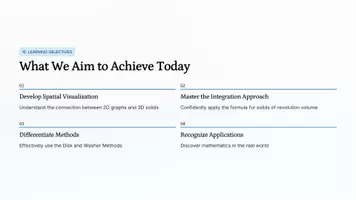


This presentation provides a clear and visually supported introduction to solids of revolution and volume calculation using integral calculus. The focus lies on understanding how two-dimensional graphs generate three-dimensional solids through rotation and how volumes are calculated using integration. The material is designed for bilingual (CLIL) mathematics instruction.
The guiding idea is to strengthen spatial visualization and conceptual understanding. Students learn how the disk and washer methods arise naturally from geometric considerations and how definite integrals are used to calculate volumes accurately.
Formation of solids of revolution
Rotation around the x-axis and y-axis
Relationship between function values and radii
Disk method for solid bodies
Washer method for hollow solids
Setting up volume integrals
Choosing correct integration limits
Units and interpretation of volume
Common exam mistakes and strategies
Real-world applications of solids of revolution
CLIL mathematics courses
Upper secondary bilingual programs
Integral calculus and applications units
Exam preparation and revision
Upper secondary students, CLIL math instruction, bilingual mathematics courses
Bilingualer Mathe-Unterricht, solids of revolution, volume calculation, integral calculus, CLIL math
Note: All included resources are also available as individual products. Overview / Didactic Focus This complete teaching bundle combines teaching concept, student materials, and presentation into a coherent CLIL-ready unit on solids of revolution and volume calculation using integral calculus. The focus lies on spatial understanding, modelling, and exam-oriented problem solving. Didactic Aim / Guiding Idea The guiding idea is to support concept-based and language-sensitive learning. Students learn how volumes arise from rotating function graphs and how definite integrals are used systematically to calculate these volumes accurately. Included Resources Teaching Concept / Lesson Plan Structured unit planning and learning objectives Differentiation for basic and advanced courses CLIL-oriented methodological guidance Teaching Material Disk method and washer method Rotation around the x-axis and y-axis Exam-oriented and modelling-based tasks Structured workspaces Presentation Visual explanation of solids of revolution Step-by-step modelling of volume integrals Suitable for introduction, consolidation, and revision Classroom Use CLIL mathematics courses Upper secondary bilingual programs Integral calculus application units Exam preparation and revision Best for Upper secondary students, CLIL math instruction, bilingual programs Keywords Bilingualer Mathe-Unterricht, solids of revolution, volume calculation, CLIL math, calculus bundle
Klassenstufen: EF (10./11. Jhg.), Q1 (11./12. Jhg.)



Bewertungen und Kommentare