


3 Materialien
49 Seiten

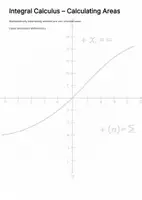
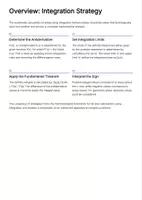


Understanding Areas Through Integration helps students move beyond procedural integration toward a deep understanding of what integrals represent.
Instead of focusing solely on formulas, this resource highlights how definite integrals describe accumulation processes and how areas above and below the x-axis influence results. Students explore real mathematical situations involving sign changes, interval decomposition, and absolute values, gaining confidence in handling complex area problems.
The structured progression from basic antiderivatives to full area calculations makes the material suitable for guided instruction, independent practice, and revision. By connecting algebraic techniques with graphical and conceptual interpretation, learners develop lasting insight into integral calculus.
Why teachers choose this resource:
Clear step-by-step analytical structure
Strong emphasis on interpretation and reasoning
Supports exam readiness and conceptual understanding
Suitable for advanced high school mathematics
A classroom-ready resource that presents integral calculus as meaningful mathematics, not mechanical computation.
Understanding integrals as accumulation, comparison, and modeling tools (Upper Secondary) This bundle focuses on the conceptual core of integral calculus as taught in German upper secondary mathematics: integrals as tools for calculating areas, modeling accumulation, and describing continuous change. Rather than limiting integration to mechanical procedures, the materials guide students toward interpretation, contextual understanding, and modeling competence. Learners explore how integrals connect local rates of change with global quantities—an essential insight for advanced mathematics and science-related fields. Written in academic English, the bundle is perfectly suited for bilingual mathematics instruction, while fully covering the content expectations of the German curriculum. Included topics (6 materials): Integral calculus: calculating areas Areas between two functions Integrals as rates of change and accumulation Optimization problems with constraints Differential equations (first order) Holistic function analysis Why teachers choose this bundle Clear link between derivatives, integrals, and modeling Strong emphasis on interpretation, units, and meaning Realistic application contexts (motion, growth, economics) Ideal for bilingual and CLIL-based mathematics courses Excellent preparation for Abitur-level modeling tasks This bundle presents integral calculus as a language for understanding real-world processes, not just a collection of formulas.
Klassenstufen: Q1 (11./12. Jhg.), Q2 (12./13. Jhg.)
The full Analysis curriculum in one coherent, bilingual-ready package This complete bundle contains all 12 analysis teaching materials and provides a fully structured learning pathway through upper secondary mathematics. It covers the entire spectrum from derivatives and curve analysis to integrals, accumulation, and differential equations. The materials are carefully coordinated to support long-term competency development, making this bundle ideal for annual planning, bilingual programs, and systematic Abitur preparation. Although written in English, the content aligns closely with German Sek II standards, terminology, and task formats—making it suitable for both traditional and bilingual classrooms. Included topics (12 materials): Derivatives as a tool for curve analysis Limits and asymptotes Inflection points and concavity Curve analysis (rational, exponential, logarithmic functions) Complete curve analysis Integral calculus: areas Areas between two functions Integrals as accumulation Optimization problems Differential equations Holistic function analysis Why this complete bundle stands out Covers the entire Analysis curriculum in one package Consistent structure and terminology across all topics Ideal for bilingual teaching and advanced courses Saves preparation time and ensures curricular coherence Suitable for multiple school years and course levels This complete bundle is a professional, future-proof solution for mathematics teachers who want to teach Analysis as a connected, meaningful, and rigorous subject.
Klassenstufen: Q1 (11./12. Jhg.), Q2 (12./13. Jhg.)



Bewertungen und Kommentare