


−26%
60 Seiten
−26%
70 Seiten


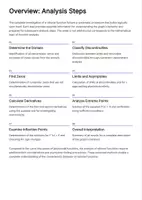


This complete bundle contains all 12 analysis teaching materials and provides a fully structured learning pathway through upper secondary mathematics. It covers the entire spectrum from derivatives and curve analysis to integrals, accumulation, and differential equations.
The materials are carefully coordinated to support long-term competency development, making this bundle ideal for annual planning, bilingual programs, and systematic Abitur preparation.
Although written in English, the content aligns closely with German Sek II standards, terminology, and task formats—making it suitable for both traditional and bilingual classrooms.
Derivatives as a tool for curve analysis
Limits and asymptotes
Inflection points and concavity
Curve analysis (rational, exponential, logarithmic functions)
Complete curve analysis
Integral calculus: areas
Areas between two functions
Integrals as accumulation
Optimization problems
Differential equations
Holistic function analysis
Covers the entire Analysis curriculum in one package
Consistent structure and terminology across all topics
Ideal for bilingual teaching and advanced courses
Saves preparation time and ensures curricular coherence
Suitable for multiple school years and course levels
This complete bundle is a professional, future-proof solution for mathematics teachers who want to teach Analysis as a connected, meaningful, and rigorous subject.
Understanding Differential Equations helps students see calculus as a language for describing continuous change. This classroom-ready resource emphasizes the full modeling cycle: translating verbal descriptions into differential equations, solving them analytically, determining constants through initial conditions, and interpreting solutions within real contexts. Students work with authentic scenarios such as population growth, radioactive decay, cooling processes, and financial models. Special attention is given to: Interpreting parameters and units Explaining solution behavior qualitatively Recognizing model assumptions and limitations Through structured tasks, partner and group activities, and reflection prompts, learners develop both technical proficiency and conceptual depth. Why teachers choose this resource: Clear analytical structure Strong link between mathematics and applications Supports exam readiness and higher-order thinking Suitable for advanced high school mathematics A powerful teaching resource that presents differential equations as meaningful models of change, not abstract formalism.
Klassenstufen: Q1 (11./12. Jhg.), Q2 (12./13. Jhg.)
Understanding Functions as Models presents function analysis as a meaningful modeling process, not a checklist of procedures. Students explore how local properties such as slope and curvature combine with global features like limits, asymptotes, and integrals to describe real-world processes. By working through complete analyses, learners develop the ability to interpret mathematical results in context, evaluate model limitations, and justify conclusions with precision. The structured analytical architecture makes this resource suitable for guided instruction, independent practice, and revision phases. It is particularly effective for developing higher-order thinking skills and mathematical communication. Why teachers choose this resource: Emphasis on conceptual connections Clear analytical structure Strong focus on interpretation and reflection Suitable for advanced high school mathematics A powerful classroom resource that presents calculus as a coherent language for understanding change and structure.
Klassenstufen: Q1 (11./12. Jhg.), Q2 (12./13. Jhg.)
Understanding Rational Functions is a comprehensive classroom resource that helps students master one of the most challenging topics in advanced mathematics: the analysis of rational functions. Instead of treating curve sketching as a checklist of calculations, this material emphasizes conceptual understanding. Students explore how limits shape function behavior, why asymptotes exist, and how local properties (such as extrema and inflection points) connect to the global structure of a graph. The resource is carefully structured, making it suitable for guided instruction, independent practice, and revision. By combining algebraic techniques with interpretative reasoning, students learn to explain what a graph does—not just how to compute it. Educational benefits: Strengthens limit and asymptote concepts Develops structured mathematical reasoning Supports exam readiness and long-term understanding Encourages interpretation over memorization An excellent choice for teachers who want students to truly understand rational functions.
Klassenstufen: Q1 (11./12. Jhg.), Q2 (12./13. Jhg.)
Integrals as Rates of Change and Accumulation is a comprehensive upper secondary mathematics resource that presents integration as a powerful tool for modeling and understanding continuous change. Rather than limiting integration to geometric area calculations, this material emphasizes the accumulation perspective: how a known rate of change leads to a total change over an interval. Students explore the fundamental relationship between derivatives and integrals through the Fundamental Theorem of Calculus, connecting local behavior to global outcomes. The resource follows a clear analytical strategy: identifying the rate function, determining integration limits, evaluating definite integrals, incorporating initial values, and interpreting results in context. Strong emphasis is placed on units, signs, and real-world meaning, helping students avoid common conceptual errors. Ideal for: Upper secondary mathematics Pre-calculus and calculus foundations Modeling and applied mathematics Exam preparation and advanced assessments A rigorous, concept-driven resource that presents integrals as essential tools for understanding change.
Klassenstufen: Q1 (11./12. Jhg.), Q2 (12./13. Jhg.)




Bewertungen und Kommentare