

−26%
60 Seiten
−26%
70 Seiten

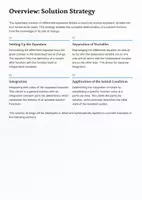


This bundle focuses on the conceptual core of integral calculus as taught in German upper secondary mathematics: integrals as tools for calculating areas, modeling accumulation, and describing continuous change.
Rather than limiting integration to mechanical procedures, the materials guide students toward interpretation, contextual understanding, and modeling competence. Learners explore how integrals connect local rates of change with global quantities—an essential insight for advanced mathematics and science-related fields.
Written in academic English, the bundle is perfectly suited for bilingual mathematics instruction, while fully covering the content expectations of the German curriculum.
Integral calculus: calculating areas
Areas between two functions
Integrals as rates of change and accumulation
Optimization problems with constraints
Differential equations (first order)
Holistic function analysis
Clear link between derivatives, integrals, and modeling
Strong emphasis on interpretation, units, and meaning
Realistic application contexts (motion, growth, economics)
Ideal for bilingual and CLIL-based mathematics courses
Excellent preparation for Abitur-level modeling tasks
This bundle presents integral calculus as a language for understanding real-world processes, not just a collection of formulas.
Understanding Differential Equations helps students see calculus as a language for describing continuous change. This classroom-ready resource emphasizes the full modeling cycle: translating verbal descriptions into differential equations, solving them analytically, determining constants through initial conditions, and interpreting solutions within real contexts. Students work with authentic scenarios such as population growth, radioactive decay, cooling processes, and financial models. Special attention is given to: Interpreting parameters and units Explaining solution behavior qualitatively Recognizing model assumptions and limitations Through structured tasks, partner and group activities, and reflection prompts, learners develop both technical proficiency and conceptual depth. Why teachers choose this resource: Clear analytical structure Strong link between mathematics and applications Supports exam readiness and higher-order thinking Suitable for advanced high school mathematics A powerful teaching resource that presents differential equations as meaningful models of change, not abstract formalism.
Klassenstufen: Q1 (11./12. Jhg.), Q2 (12./13. Jhg.)
Understanding Functions as Models presents function analysis as a meaningful modeling process, not a checklist of procedures. Students explore how local properties such as slope and curvature combine with global features like limits, asymptotes, and integrals to describe real-world processes. By working through complete analyses, learners develop the ability to interpret mathematical results in context, evaluate model limitations, and justify conclusions with precision. The structured analytical architecture makes this resource suitable for guided instruction, independent practice, and revision phases. It is particularly effective for developing higher-order thinking skills and mathematical communication. Why teachers choose this resource: Emphasis on conceptual connections Clear analytical structure Strong focus on interpretation and reflection Suitable for advanced high school mathematics A powerful classroom resource that presents calculus as a coherent language for understanding change and structure.
Klassenstufen: Q1 (11./12. Jhg.), Q2 (12./13. Jhg.)
Integrals as Rates of Change and Accumulation is a comprehensive upper secondary mathematics resource that presents integration as a powerful tool for modeling and understanding continuous change. Rather than limiting integration to geometric area calculations, this material emphasizes the accumulation perspective: how a known rate of change leads to a total change over an interval. Students explore the fundamental relationship between derivatives and integrals through the Fundamental Theorem of Calculus, connecting local behavior to global outcomes. The resource follows a clear analytical strategy: identifying the rate function, determining integration limits, evaluating definite integrals, incorporating initial values, and interpreting results in context. Strong emphasis is placed on units, signs, and real-world meaning, helping students avoid common conceptual errors. Ideal for: Upper secondary mathematics Pre-calculus and calculus foundations Modeling and applied mathematics Exam preparation and advanced assessments A rigorous, concept-driven resource that presents integrals as essential tools for understanding change.
Klassenstufen: Q1 (11./12. Jhg.), Q2 (12./13. Jhg.)
Areas Between Two Functions is a comprehensive upper secondary mathematics resource that deepens students’ understanding of integral calculus by extending area calculations beyond the x-axis. Students learn that calculating areas between two graphs requires a structured analytical strategy: determining intersection points, identifying upper and lower functions, forming the difference function, and evaluating definite integrals. The material emphasizes the crucial distinction between signed integrals and geometric area, helping learners avoid common conceptual errors. A strong focus is placed on: correct determination of integration limits handling multiple intersection points and interval decomposition algebraic simplification of difference functions precise interpretation of results without relying on graphs By working through complete solution paths and error analyses, students develop mathematical rigor, clarity, and exam readiness. Ideal for: Upper secondary mathematics Pre-calculus and calculus foundations Exam preparation and advanced assessments A rigorous and concept-driven resource for mastering area calculations using definite integrals.
Klassenstufen: Q1 (11./12. Jhg.), Q2 (12./13. Jhg.)




Bewertungen und Kommentare