

52 Seiten
60 Seiten
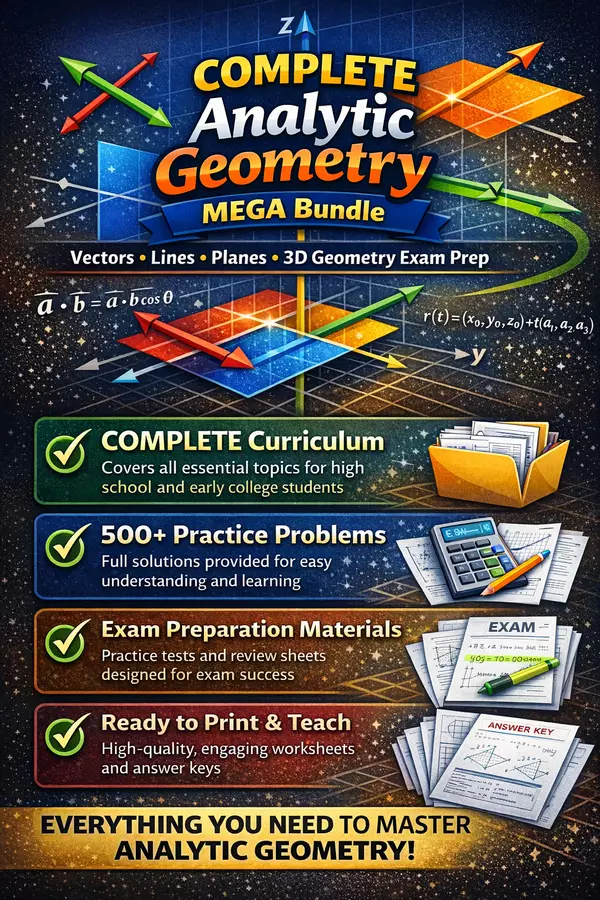
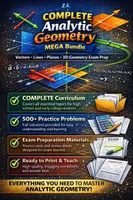

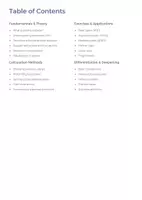


This Complete Analytic Geometry Mega Bundle offers a comprehensive, curriculum-aligned learning package for upper secondary mathematics in bilingual and CLIL-based classrooms.
It covers all central topics of analytic geometry, guiding students from vector basics through 3D geometry to complex exam and Abitur-style problem solving.
The bundle is designed to support both conceptual understanding and exam readiness, while simultaneously strengthening subject-specific mathematical English.
This bundle follows a clearly structured progression that mirrors how analytic geometry is taught and assessed in upper secondary education.
Students learn to:
understand and apply vector-based methods
analyze spatial relationships systematically
justify mathematical procedures using precise language
interpret results in applied and real-world contexts
Special emphasis is placed on operator awareness, multi-step reasoning, and structured solution strategies, which are essential in bilingual exam settings.
Vectors in three-dimensional space
Vector operations and representations
Lines in space (parametric form and applications)
Planes in space (different representations and conversions)
Positional relationships between lines and planes
Distance calculations in space
Angle calculations using the dot product
Context-based geometry problems
Real-world modeling tasks
Interpretation of geometric results
Transfer of mathematical methods to applied situations
Complex multi-step exam-style tasks
Problems covering higher-order thinking (AFB II–III)
Structured solution approaches
Typical student errors and prevention strategies
Cumulative review and consolidation tasks
Exam simulations and reflection activities
All materials are designed to support a didactically coherent learning pathway:
Concept development with clear explanations
Guided practice with increasing complexity
Independent problem-solving
Error analysis and reflection
Exam-oriented application and simulation
This approach ensures deep understanding, language development, and long-term retention.
This bundle is ideal for:
Bilingualer Mathe-Unterricht
CLIL mathematics courses
Upper secondary analytic geometry units
Long-term curriculum planning
Exam and Abitur preparation
Guided classroom instruction
Independent and differentiated student work
Bilingual and CLIL classrooms
Upper secondary mathematics
Analytic geometry units
Exam-focused and competency-based teaching
Teachers seeking a complete, ready-to-use geometry bundle
Covers the entire analytic geometry curriculum in one package
Ensures consistent terminology and language scaffolding
Supports mathematical reasoning and academic language development
Reduces preparation time for teachers
Works seamlessly for instruction, practice, and revision
After working with this bundle, students will be able to:
Confidently work with vectors, lines, and planes in 3D space
Solve complex analytic geometry problems step by step
Apply mathematical concepts to real-world contexts
Communicate solutions clearly using subject-specific English
Approach exams with confidence and structured strategies
Bilingualer Mathe-Unterricht, bilingual math bundle, CLIL mathematics, analytic geometry, vectors lines planes, upper secondary math, exam preparation geometry
👉 Please note: The website also offers linked bundle options combining this presentation with teaching materials and a complete teaching concept for coherent lesson planning.This presentation for upper secondary mathematics provides a clear and intuitive introduction to lines in three-dimensional space using the parametric form.Students learn how lines are represented by a position vector and a direction vector and how the parameter controls movement along the line. Visual examples and step-by-step explanations support conceptual understanding, making the abstract topic accessible and meaningful.Key topics include: review of vector basics, interpretation of position and direction vectors, generating points on a line using the parameter, checking whether a point lies on a given line, common misconceptions and how to avoid them. The presentation is especially suitable for CLIL and bilingual classrooms, as it combines precise mathematical language with strong visual support. Resource type: Presentation Subject: Mathematics – Analytic Geometry Level: Upper Secondary (Grades 10–12 / CLIL)
Klassenstufen: Q1 (11./12. Jhg.), Q2 (12./13. Jhg.)
👉 Please note: The website offers linked bundle options combining this presentation with teaching materials and a complete teaching concept for a coherent analytic geometry unit. This upper secondary mathematics presentation provides a clear and structured introduction to the relative positions of lines and planes in three-dimensional space. Students systematically explore all possible configurations using parametric equations, systems of equations, and vector products, while continuously linking algebraic results to geometric interpretation. Visual models and real-world examples support spatial reasoning and conceptual understanding. Key topics include: line–line relationships (parallel, intersecting, identical, skew), line–plane relationships (intersecting, parallel, contained), plane–plane relationships (parallel, identical, intersecting), interpreting solution sets of equation systems, common misconceptions and how to avoid them. This presentation is especially suitable for CLIL and bilingual classrooms, combining precise mathematical language with strong visual support. Resource type: Presentation Subject: Mathematics – Analytic Geometry Level: Upper Secondary (Grades 10–12 / CLIL)
Klassenstufen: Q1 (11./12. Jhg.), Q2 (12./13. Jhg.)
👉 Please note: Linked bundle options combine this teaching material with an instructional presentation and a complete teaching concept for a full analytic geometry unit. This upper secondary teaching material provides a comprehensive and structured approach to relative positions of lines and planes in three-dimensional space. It supports students in developing both procedural skills and conceptual understanding in analytic geometry. Students work through clearly explained methods for: line–line relationships (parallel, intersecting, identical, skew), line–plane relationships, plane–plane relationships, distance and angle calculations, interpreting algebraic results geometrically. The material includes step-by-step explanations, scaffolded practice tasks, and differentiated exercises covering lower, middle, and higher cognitive demand levels. Visual representations and real-world modeling tasks support spatial reasoning, making the resource well suited for CLIL and bilingual classrooms. Resource type: Teaching material / worksheets Subject: Mathematics – Analytic Geometry Level: Upper Secondary (Grades 10–12 / CLIL)
Klassenstufen: Q1 (11./12. Jhg.), Q2 (12./13. Jhg.)
👉 Please note: Linked bundle options combine this teaching material with an instructional presentation and a complete teaching concept for a full analytic geometry unit. This upper secondary teaching material provides a structured and concept-based approach to distance calculations in three-dimensional space. It supports students in developing both procedural fluency and geometric understanding. The material focuses on the perpendicular distance principle and guides students through: distance from a point to a line, distance from a point to a plane, interpretation of algebraic results in geometric contexts. Included are clear explanations, worked examples, scaffolded practice tasks, and differentiated exercises covering lower, intermediate, and higher cognitive demand levels. Visual references and modeling tasks support spatial reasoning, making this resource well suited for CLIL and bilingual classrooms. Resource type: Teaching material / worksheets Subject: Mathematics – Analytic Geometry Level: Upper Secondary (Grades 10–12 / CLIL)
Klassenstufen: Q1 (11./12. Jhg.), Q2 (12./13. Jhg.)




Bewertungen und Kommentare