

−26%
60 Seiten
−26%
70 Seiten




Category: Mathematics → Statistics & Probability
Grade Levels: Grades 9–12 (Upper Secondary / High School)
Resource Types: Unit Plans · Teaching Guides · Worksheets · Workbooks · Presentations
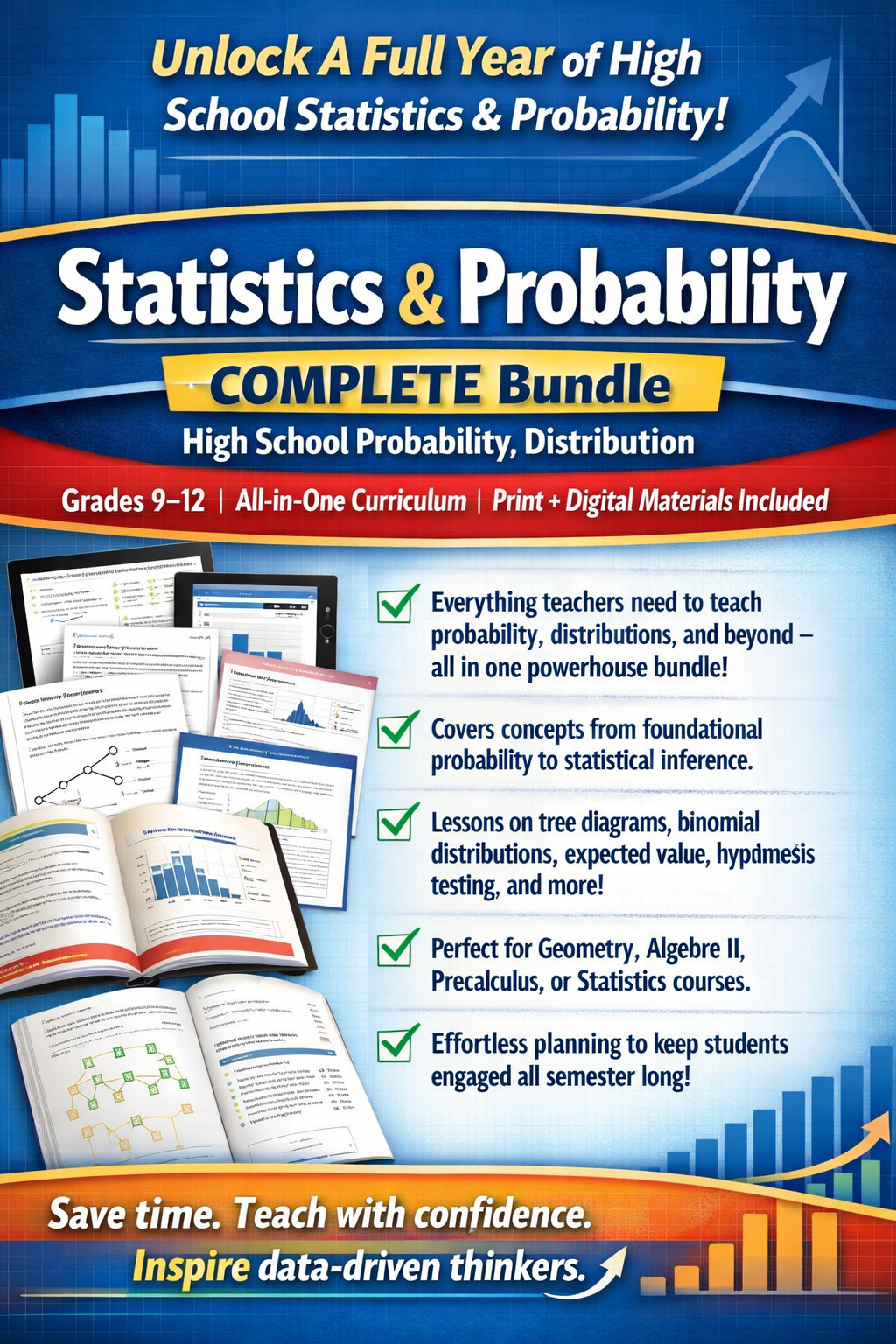
This Statistics & Probability COMPLETE Bundle provides a full high school statistics curriculum for Grades 9–12, specifically designed for bilingual (CLIL) mathematics classrooms and English-language instruction.
The bundle covers the entire progression from fundamental probability concepts to advanced statistical inference, including hypothesis testing and critical evaluation of data.
It is ideal for:
High school Probability & Statistics courses
Bilingual / CLIL mathematics instruction
Geometry, Algebra II, Precalculus, or integrated math programs
Semester-long or full-year statistics courses
Teachers seeking a complete, ready-to-teach statistics curriculum
Rather than focusing on formulas alone, this bundle emphasizes:
statistical reasoning and conceptual understanding
interpretation and communication of results
decision-making based on data
typical misconceptions in probability and statistics
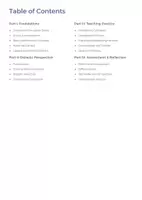
The bundle includes 12 fully developed core units, integrated into a coherent teaching sequence:
Probability foundations and randomness
Laplace experiments and equally likely outcomes
Tree diagrams and path rules
Conditional probability and two-way tables
Random variables and probability distributions
Binomial distribution
Expected value and variance
Cumulative probability and decision rules
Simulations and stochastic models
Hypothesis testing
Type I and Type II errors
Critical reading and evaluation of statistical data
Each unit includes clear explanations, structured tasks, and classroom-ready materials, suitable for bilingual learners.
In addition to the core units, this bundle includes:
extended lesson plans for probability foundations
step-by-step instructional slide decks
concept-driven introductions and lesson closures
visual explanations for inference and hypothesis testing
teaching concepts for decision rules and statistical reasoning
👉 These materials are not sold separately and significantly increase instructional depth and flexibility.
To support modeling, vector-based reasoning, and mathematical interpretation, the bundle also includes teaching concepts from analytic geometry, such as:
vectors and vector interpretation
lines in space (parametric representations)
planes in space and spatial reasoning
These concepts strengthen mathematical thinking and support advanced probability and statistics contexts, especially in modeling and interpretation tasks.
probability and statistics
high school statistics
bilingual mathematics
CLIL math statistics
probability unit high school
statistics bundle
binomial distribution
conditional probability
hypothesis testing
expected value and variance
cumulative probability
simulations in statistics
data analysis and interpretation
High school Probability & Statistics courses
Bilingual / CLIL mathematics instruction (EN)
Geometry, Algebra II, Precalculus, or Statistics
Semester-long or full-year statistics teaching
Exam and standardized test preparation
Teachers who want a complete, concept-driven statistics curriculum
This Statistics & Probability COMPLETE Bundle is a true all-in-one solution for high school and bilingual mathematics instruction.
With 12 core units, 20+ exclusive teaching concepts and presentations, and a clear progression from probability foundations to statistical inference, it eliminates the need to combine separate resources and ensures consistent, high-quality instruction throughout the course.
This teaching material for upper secondary mathematics provides a clear and structured introduction to two-way tables and conditional probability, making it especially suitable for CLIL and bilingual classrooms. The material supports learners in moving confidently between different representations, including absolute and relative frequencies, tables, and probability notation. Step-by-step explanations and carefully chosen examples help students understand not only how to calculate probabilities, but also how to interpret results in context. Typical reasoning errors are addressed explicitly, supporting conceptual clarity and language-sensitive learning. The inclusion of real-life applications and reflection tasks encourages students to rely on mathematical reasoning rather than intuition. This resource is well suited for extended teaching units, exam preparation, and concept consolidation in upper secondary education.
Klassenstufen: Q1 (11./12. Jhg.), Q2 (12./13. Jhg.)
👉 Please note: On the website you will also find linked bundle options that combine this teaching material with a presentation and a full teaching concept for consistent lesson planning. This teaching material for upper secondary mathematics provides a structured and language-sensitive introduction to expected value, variance, and standard deviation, making it particularly suitable for CLIL and bilingual classrooms. Learners develop a precise understanding of long-term averages and variability, supported by multiple representations and carefully chosen examples. The focus on interpretation helps students connect formulas to real-world meaning and evaluate risk and uncertainty mathematically. Step-by-step explanations, graded exercises, and reflection tasks support conceptual understanding while maintaining mathematical rigor. The material integrates smoothly into extended probability units and prepares students for advanced topics in statistics. Resource type: Teaching Material Subject: Mathematics – Probability Level: Upper Secondary (Grades 10–12 / CLIL)
Klassenstufen: Q1 (11./12. Jhg.), Q2 (12./13. Jhg.)
👉 Please note: The website also offers linked bundle options combining this presentation with teaching materials and a complete teaching concept for coherent lesson planning. This presentation for upper secondary mathematics introduces students to the critical evaluation of statistical information, making it particularly suitable for CLIL and bilingual classrooms. Students learn why statistics appear authoritative and how this perceived objectivity can be used to mislead or manipulate. The presentation systematically explores common techniques such as distorted axes, selective data use, misleading visualizations, small sample sizes, and false causal claims. Through real-world examples from media, advertising, and politics, learners develop tools to evaluate diagrams, percentages, averages, and correlations. Reflection tasks and discussion prompts encourage critical thinking and evidence-based argumentation. This presentation is ideal for strengthening statistical literacy, media competence, and informed decision-making in upper secondary education. Resource type: Presentation Subject: Mathematics – Probability & Statistics Level: Upper Secondary (Grades 10–12 / CLIL)
Klassenstufen: Q1 (11./12. Jhg.), Q2 (12./13. Jhg.)
👉 Please note: On the website you will also find linked bundles combining this presentation with teaching materials and a full teaching concept for coherent lesson planning. This presentation for upper secondary mathematics provides a clear and language-sensitive introduction to simulations and stochastic models, making it especially suitable for CLIL and bilingual classrooms. Learners investigate how random experiments behave in the long run and how simulations help approximate probabilities when theoretical calculations are complex or impractical. Concepts such as relative frequency, convergence, and the law of large numbers are explained using intuitive visuals and step-by-step reasoning. Real-world applications from weather forecasting, finance, medicine, and traffic planning illustrate why simulations play a central role in modern decision-making under uncertainty. Typical reasoning errors are addressed explicitly to support deep understanding. The presentation integrates smoothly into extended probability units and prepares students for further work with stochastic models and data analysis. Resource type: Presentation Subject: Mathematics – Probability Level: Upper Secondary (Grades 10–12 / CLIL)
Klassenstufen: Q1 (11./12. Jhg.), Q2 (12./13. Jhg.)




Bewertungen und Kommentare