

1 Seite


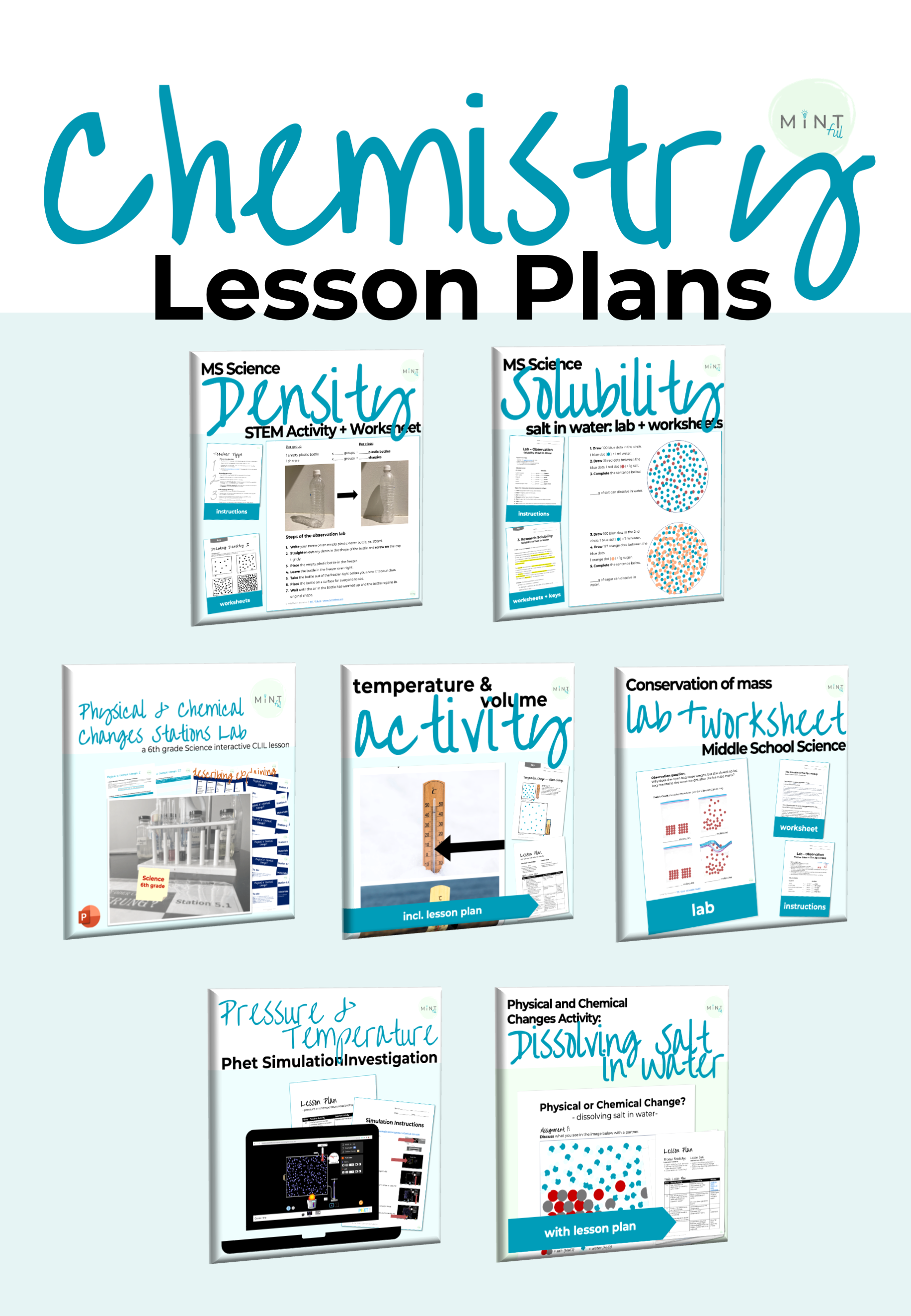
This chemistry lesson bundle includes integrated physics and chemistry lesson plans and chemistry lab lesson plans.
Use this chemistry lesson bundle for chemistry unit plans around the following topics:
The chemistry lab lesson plans for solubility salt in water and physical and chemical changes allow for hands-on learning and are easy to set up and execute.
Which previous knowledge should my learners already have?
Learners should already be able to
3 Secret Tips for you:
Click here to get some extra help with lesson planning.
Use Science Sentence Starters for your lab discussions.
Try this new approach to assessing your learners and save tons of time grading.
In which file format will I receive the chemistry lesson bundle?
Not-editable secured PDF files
Have you ever assessed your students by having them draw?
States of Matter Review Activities and Assessment
Hey, and I would love to hear your thoughts on this chemistry lesson bundle. Whether you already use it in class or are not sure if it's the right fit for you, reach out .
This Solubility Salt In Water Lab is simply done and has a great learning effect. Your learners explore the solubility salt in water themselves by stirring one gram of salt at a time in 100ml of water until no more salt dissolves. Here is an idea: Use the same instructions for a solubility sugar in water lab, but know that sugar turns into syrup and as you know, can get veeeeeery sticky.After your learners complete the lab, they create a model of solubility of sugar and water by simply drawing the water molecules and salt molecules in a circle. (Watch the video so you know what I mean.)The 3rd way learners explore the solubility salt in water vs. solubility sugar in water is by reading a few paragraphshighlighting the most important information and thenAnswering a couple questions in a full sentence. Use this Solubility Salt in Water Lab in your middle school Science classroom once your students already know:the composition of molecules and atomsthe states of matterhow temperature affects molecular movementRules for ScienceNote how this activity requires limited language skills, at least in the first 2 parts. Your English language learners will already have done the lab and drawn the models, before reading the text.Remember, to use the Science Sentence Starters with your class when discussing the solubility of salt and water verbally. If you need help with the actual lesson planning for this law of conservation of mass lab, check out your FREE guide:FREE resource #1: The 4Ds of Lesson PlanningIn which file format will I receive the resource?Not-editable secured PDF fileWhat does this resource include?teacher prep & lab prep noteslab notes printable2 solubility worksheetsanswer keysWhat can this material be used for?6th grade science projects6th grade science experimentsProperties of matter unitLanguage inclusive classroomCLIL - content and language integrated learningOther ideas that might be helpful for you:Science Sentence StartersRules for ScienceTeam Roles for Group ProjectsLaw of Conservation of Mass LabDensity STEM activity with worksheetDo you have questions, ideas or just want to say “Hi!”?→ Reach out :)! Also, if you want a list of free tips about how to use plain language to make your own classroom materials more English language learner accessible, I have another FREE resource for you!FREE resource #2: 10 tips to get started using plain language
Klassenstufen: 6. Klasse
The pressure and temperature relationship is part of the states of matter unit in grade 6 Science. This activity offers an interactive way to explore the pressure and temperature relationship through a Phet simulation with an exploration guide.What is the learning goal of this lesson?Your learners will be able to explain the pressure and temperature relationship and apply their new knowledge to formulate hypotheses on how a pressure cooker works.While not explicitly included in this resource, learners could also create a pressure and temperature chart based on the values they can measure using the Phet simulation.Which previous knowledge should my learners already have?Learners will already be able to explain the relationship between volume and temperature including the fact that volume and temperature are directly proportional.In which file format will I receive the pressure and temperature relationship resource?Not-editable secured PDF fileWhat does this resource include?1 Lesson plan 1 step-by-step guide for the simulation1 worksheet1 worksheet keyRemember, to use the Science Sentence Starters with your class to make your classroom discussion accessible to English language learners. If you need help with the actual lesson planning check out your FREE guide: The 4Ds of Lesson PlanningWhich other resources do you have that I could use?Science Density STEM ActivityTemperature and Volume ActivitySolubility Salt in WaterScience Sentence StartersI am excited to hear how your lesson will go, Good luck and have funSusann
Klassenstufen: 6. Klasse
This temperature and volume activity helps your learners understand how a substance expands when it becomes warmer. Use this temperature and volume activity to explain the relationship between volume and temperature and also answer the question How does a thermometer work?Volume and temperature are directly proportional. Instead of a temperature volume diagram (which you can also include in your lesson) I created a temperature and volume activity based on drawing a model.I love drawing models because models show instead of tell. If you have a diverse learner group with English language learners drawing models is a great way to make your learning content accessible. The relationship between volume and temperature becomes clear when students draw the same amount of molecules WITH EQUAL DISTANCE BETWEEN THEM in a box double the size. Khan Academy has an article on temperature volume diagrams, if you want to add it to this temperature and volume activity: https://www.khanacademy.org/science/physics/thermodynamics/laws-of-thermodynamics/a/what-are-pv-diagrams Learning GoalYour learners will be able to 1. Explain the relationship between temperature and volume2. Explain how a thermometer worksUse this temperatur and volume activity in your middle school Science classroom once your learners are already able to: describe the molecular structure of atoms and moleculesdraw a molecular model of H2O Explain the states of matterDescribe the relationship between temperature and molecular movementfollow the Rules for ScienceRemember, to use the Science Sentence Starters with your class to make your classroom discussion accessible to English language learners. If you need help with the actual lesson planning check out your FREE guide: The 4Ds of Lesson PlanningIn which file format will I receive the resource?Not-editable secured PDF fileWhat does this resource include?1 Lesson plan → Click here for more help. 2 graphics of salt dissolving in water2 worksheets with 4 assignmentsWhat can this material be used for?Properties of matter unitLanguage inclusive classroomCLIL - content and language integrated learningOther ideas that might be helpful for you:Science Density STEM Activity (with worksheet)Solubility Salt in WaterStates of Matter Review Activities and AssessmentScience Sentence StartersDo you have questions, ideas or just want to say “Hi!”?→ Reach out :)! Also, if you want a list of free tips about how to use plain language to create your own English language learner accessible resources, I have another FREE resource for you! 10 tips to get started using plain languageI am excited to hear how your lesson will go, Good luck and have fun 🙂Susann
Klassenstufen: 6. Klasse
The Physical and Chemical Changes Stations Lab is a 6th grade Science CLIL lesson plan filling 3 periods with interactive content engagement & intentional language skill building.What will learners do?In this Science CLIL lesson plan learners walk through 5 stations of a physical and chemical changes stations lab and complete little experiments. Learners then fill out the worksheet that accompanies the physical and chemical changes stations lab. As part of the CLIL lesson plan learners use a vocabulary list and sentence builder exercises to describe and explain their observations. What does this material contain? A list of materials for the teacher to set up the physical and chemical changes stations lab A vocabulary list 6 slides listing the materials needed and steps to be completed for each station 1 slide with describing sentences building blocks 1 slide with explaining sentences building blocks What related resources are there?Stationsarbeit mit Arbeitsblatt: Physikalische und Chemische Veränderungen (GER)Formulierungshilfen Naturwissenschaften Poster / sentence starters science posters (GER)What can this material be used for? Science CLIL lesson plans English immersion lesson plans ESL lesson plansDo you have questions, ideas or just want to say “Hi!”?→ Reach out :)! I wish you the best experience with your learners, -SusannP.s. Oh, hey, I wanted to ask you if you needed any help with lesson planning?I might have something for you ← Just click the link for a FREE guide for you.
Klassenstufen: 6. Klasse




Bewertungen und Kommentare