


eduki Qualität
74 Seiten
eduki Qualität
12 Seiten
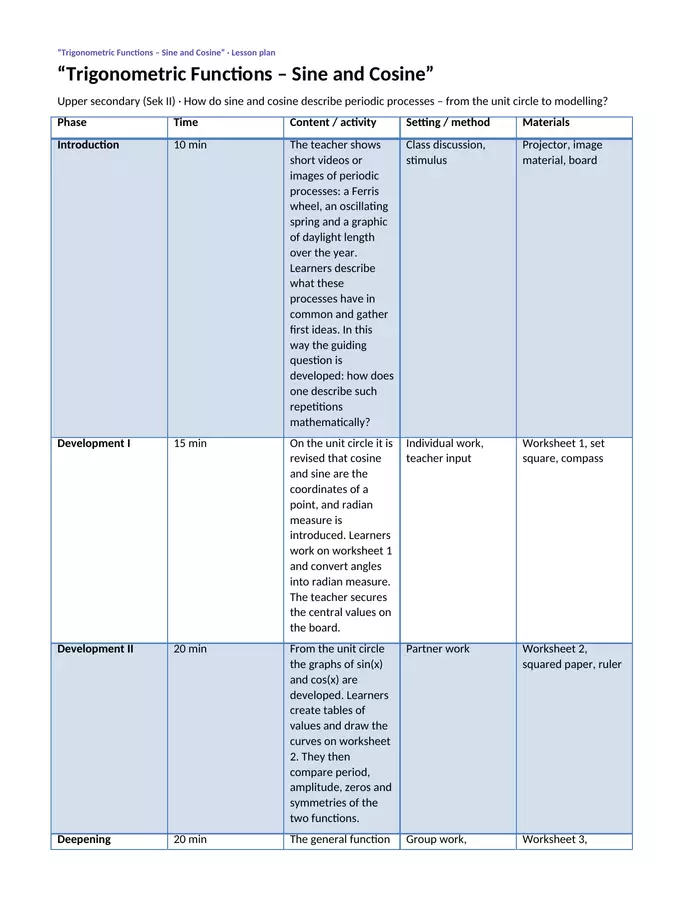
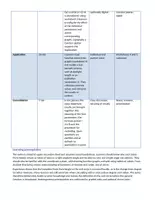


Trigonometric Functions – Sine and Cosine: an English-language Mathematics teaching unit for Grades 11–13. How do sine and cosine describe periodic processes – from the unit circle to modelling? Five worksheets connect explanatory texts, mathematical vocabulary and practice tasks with applying methods and interpreting results. Detailed solutions, a lesson plan and a classroom presentation accompany the student material.
Sine and cosine on the unit circle and radian measure
I can interpret sine and cosine as coordinates on the unit circle and state angles in radian measure.
Drawing and reading the graphs of sin(x) and cos(x)
I can draw the graphs of sin(x) and cos(x) with their properties and read off values.
Applying the parameters a, b, c and d
I can determine the effect of the parameters in f(x)=a·sin(b·(x−c))+d and produce graphs.
Analysing function terms from graphs
I can determine the parameters a, b, c and d from a given graph and set up the function term.
Modelling periodic real-world contexts
I can model real periodic processes with sine or cosine functions and interpret the results.
The worksheets introduce the key concepts before learners use them in calculations and applications. Tasks ask pupils to explain a method, choose a suitable procedure, carry out the steps and justify or interpret the result. Core and optional tasks allow the teacher to select the amount of work and support. The aim is to connect a correct result with an understandable solution path.
Five worksheets with explanatory texts, mathematical vocabulary and differentiated tasks.
A detailed answer and expected-outcome document with worked solution guidance.
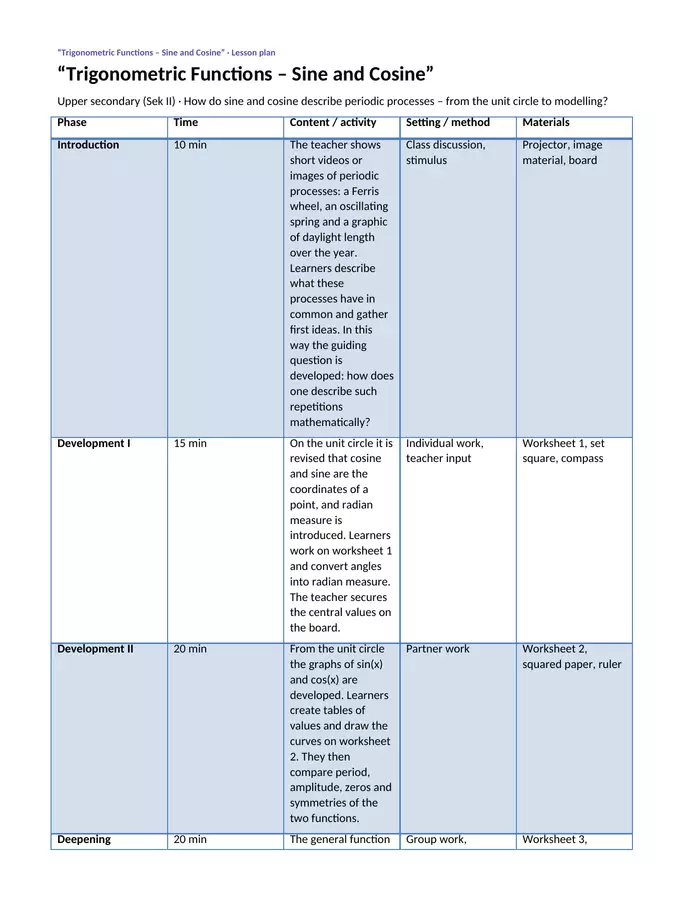
A teacher lesson plan with prerequisites, competencies, suggested phases, methodology, differentiation and preparation.
A classroom slide deck.
One combined printable PDF and a separate archive containing editable text documents and the presentation.
Begin with a shared example and ask learners to identify what is known, what is being asked and which method fits. Compare solution approaches, make intermediate steps visible and then move to independent practice. Pair work can help pupils explain a choice and spot an error before checking against the solutions. The worked answers support both classroom discussion and targeted revision of a particular step.
For the series the five worksheets with the corresponding solutions are needed, as well as the presentation with seven slides for the introduction and consolidation. Every learner needs a set square, ruler, pencil, squared paper and a scientific calculator. For drawing the graphs, paper with fine squares or prepared coordinate paper is recommended. Optionally, a function plotter, for example as free software or an app on tablets, increases the learning gain in the deepening phase. The teacher should calculate the extreme values and periods of the examples used in advance so that the results can be secured quickly. A handout with the most important formulas and the values of sin and cos to be memorised for 0, π/6, π/4, π/3 and π/2 facilitates the consolidation and serves as a permanent reference.
Use the teacher plan to match the number of tasks, prerequisite knowledge and pace to the class. The editable files allow examples to be adjusted and additional working space or hints to be added. Where calculators, plotting tools or other classroom equipment are mentioned, provide the relevant tools according to the selected activities. The download supplies teaching documents and slides rather than software or equipment.
Which language is included? This is the English edition; German files are not included. Are answers provided? Yes. Detailed sample answers and expected outcomes accompany the worksheets. Can I edit it? Text documents and the slide deck are supplied in editable form in the separate archive. Can I select individual worksheets? The files are organised by worksheet, so teachers can choose a section for focused practice or use the sequence together.
Source and tool notes from the supplied material are retained. Texts, tasks, answers and design were generated with AI, as declared in the listing. PDF versions of the slides are included in the combined page count; identical editable versions are not counted again.
Download size: 25 pages in the combined PDF. Slide pages are included in this count. The editable archive contains 7 text documents and 1 slide deck.
Functions: Exponentials, Growth, Decay, Sine and Cosine: this bundle contains 2 complete teaching resources with 50 PDF pages in total. Math Grades 11–13. All included resources are the English-language editions. They can be taught separately or selected to build a connected sequence around the named topics.Use the individual packs to introduce concepts, practise subject vocabulary, compare examples and support written or practical outcomes. Select tasks according to learners’ prior knowledge and the level stated in each resource; the bundle is a collection of the listed complete products, rather than a newly sequenced textbook or a promise that every task suits every grade.Which resources are included?Math Grades 11–13: Exponential Functions, Growth, Decay, Half-Life and Doubling Time | English Edition · 25 pagesThe e-function and exponential growth processes: an English-language Mathematics teaching unit for Grades 11–13. How do we describe and calculate exponential growth and decay with the e-function? Five worksheets connect explanatory texts, mathematical vocabulary and practice tasks with applying methods and interpreting results. Detailed solutions, a lesson plan and a classroom presentation accompany the student material.The worksheets introduce the key concepts before learners use them in calculations and applications. Tasks ask pupils to explain a method, choose a suitable procedure, carry out the steps and justify or interpret the result. Core and optional tasks allow the teacher to select the amount of work and support. The aim is to connect a correct result with an understandable solution path.Trigonometric Functions – Sine and Cosine | Math Grades 11–13 | 5 Worksheets & Worked Answers | English Edition · 25 pagesTrigonometric Functions – Sine and Cosine: an English-language Mathematics teaching unit for Grades 11–13. How do sine and cosine describe periodic processes – from the unit circle to modelling? Five worksheets connect explanatory texts, mathematical vocabulary and practice tasks with applying methods and interpreting results. Detailed solutions, a lesson plan and a classroom presentation accompany the student material.The worksheets introduce the key concepts before learners use them in calculations and applications. Tasks ask pupils to explain a method, choose a suitable procedure, carry out the steps and justify or interpret the result. Core and optional tasks allow the teacher to select the amount of work and support. The aim is to connect a correct result with an understandable solution path.Files, preparation and frequently asked questionsYou receive the complete files of the listed individual products, with the worksheets, answers, teaching notes and presentations described in each listing. File formats and additional preparation vary by resource: consult each included product for its exact inventory. PDF page totals count the complete printable editions, including covers, teaching notes and answers; editable versions are not counted again as extra pages.Preparation requirements and any teacher-provided equipment or media are stated in the individual resources. Review those notes before choosing practical activities.Does this add new worksheets to the individual packs? No. This offer groups the named complete products. If you already own one or more, check the overlap before purchasing. Text, tasks, answers and the supplied cover graphics were fully created with AI. Source references and resource-specific notes are retained in the individual files. The resources have not been classroom tested.Sum of individual prices: 44.98 €. Bundle price: 39.99 € (saving: 11.1%).
Klassenstufen: EF (10./11. Jhg.), Q1 (11./12. Jhg.)



Bewertungen und Kommentare