


eduki Qualität
74 Seiten
eduki Qualität
12 Seiten
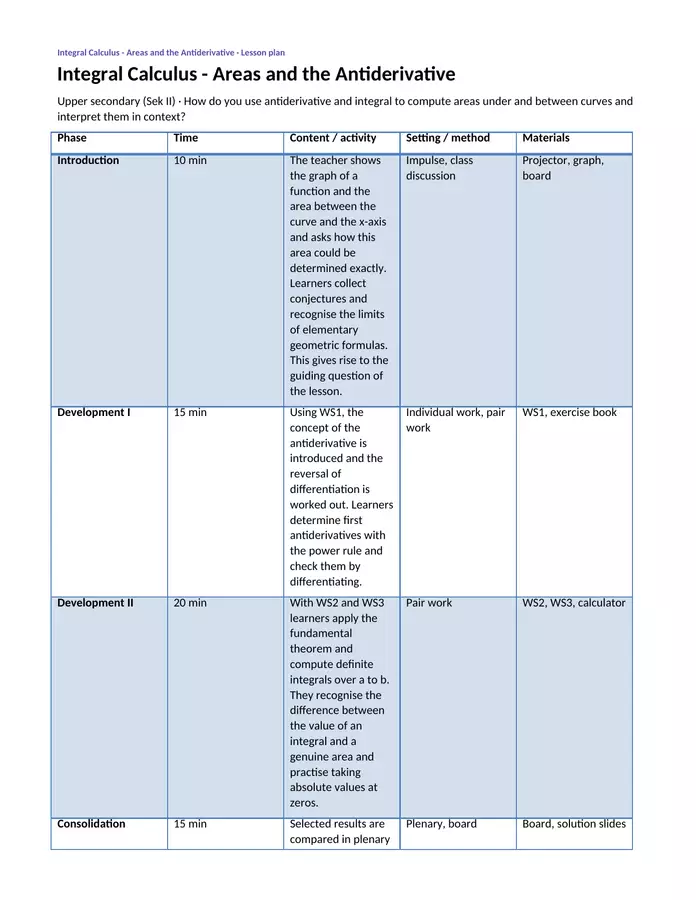
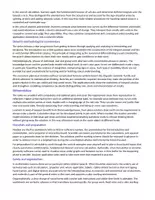
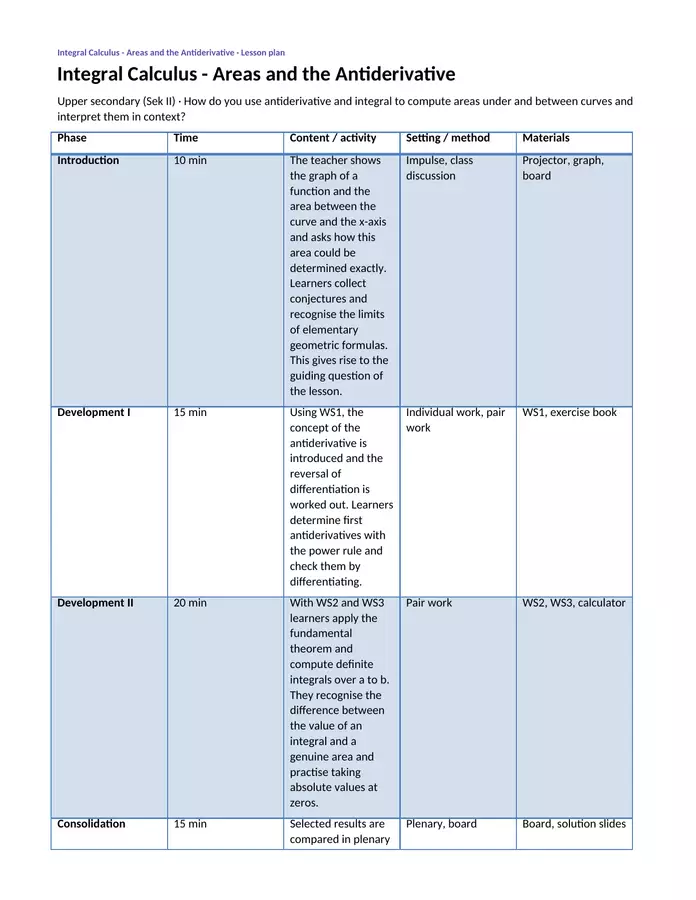


Integral Calculus - Areas and the Antiderivative: an English-language Mathematics teaching unit for Grades 11–13. How do you use antiderivative and integral to compute areas under and between curves and interpret them in context? Five worksheets connect explanatory texts, mathematical vocabulary and practice tasks with applying methods and interpreting results. Detailed solutions, a lesson plan and a classroom presentation accompany the student material.
Antiderivative and indefinite integral
I can determine an antiderivative of a function and understand the indefinite integral as the set of all antiderivatives.
Computing the definite integral
I can use the fundamental theorem of calculus to compute definite integrals over the bounds a to b.
Areas between a curve and the x-axis
I can compute the area between a graph and the x-axis and correctly account for the sign of partial areas.
Analysing areas between two curves
I can determine the area between two function graphs by computing the intersection points and integrating over the difference function.
Applications: stocks from rates of change
I can use the integral to compute a total stock or total change from a given rate of change in a real-world context.
The worksheets introduce the key concepts before learners use them in calculations and applications. Tasks ask pupils to explain a method, choose a suitable procedure, carry out the steps and justify or interpret the result. Core and optional tasks allow the teacher to select the amount of work and support. The aim is to connect a correct result with an understandable solution path.
Five worksheets with explanatory texts, mathematical vocabulary and differentiated tasks.
A detailed answer and expected-outcome document with worked solution guidance.
A teacher lesson plan with prerequisites, competencies, suggested phases, methodology, differentiation and preparation.
A classroom slide deck.
One combined printable PDF and a separate archive containing editable text documents and the presentation.
Begin with a shared example and ask learners to identify what is known, what is being asked and which method fits. Compare solution approaches, make intermediate steps visible and then move to independent practice. Pair work can help pupils explain a choice and spot an error before checking against the solutions. The worked answers support both classroom discussion and targeted revision of a particular step.
Needed are the five worksheets WS1 to WS5 in sufficient number, the presentation for the introduction and consolidation, and a projector or interactive board. Scientific calculators are helpful for the calculations, and squared paper or a geometry book for the sketches. The solutions and the marking scheme should be reviewed in advance in order to address errors in a targeted way during the consolidation phases and to keep the lesson focused. For preparation it is advisable to work through the central examples once yourself and to plan a clean board layout that clearly summarises antiderivative, fundamental theorem and area calculation. Optionally, a function plotter or dynamic geometry software can be used to visualise areas under graphs and between curves. A time buffer for the deepening phase is sensible, because application tasks tend to take more time than expected in practice.
Use the teacher plan to match the number of tasks, prerequisite knowledge and pace to the class. The editable files allow examples to be adjusted and additional working space or hints to be added. Where calculators, plotting tools or other classroom equipment are mentioned, provide the relevant tools according to the selected activities. The download supplies teaching documents and slides rather than software or equipment.
Which language is included? This is the English edition; German files are not included. Are answers provided? Yes. Detailed sample answers and expected outcomes accompany the worksheets. Can I edit it? Text documents and the slide deck are supplied in editable form in the separate archive. Can I select individual worksheets? The files are organised by worksheet, so teachers can choose a section for focused practice or use the sequence together.
Source and tool notes from the supplied material are retained. Texts, tasks, answers and design were generated with AI, as declared in the listing. PDF versions of the slides are included in the combined page count; identical editable versions are not counted again.
Download size: 25 pages in the combined PDF. Slide pages are included in this count. The editable archive contains 7 text documents and 1 slide deck.
Calculus: Derivatives, Optimisation, Curve Sketching and Integration: this bundle contains 4 complete teaching resources with 100 PDF pages in total. Math Grades 11–13. All included resources are the English-language editions. They can be taught separately or selected to build a connected sequence around the named topics.Use the individual packs to introduce concepts, practise subject vocabulary, compare examples and support written or practical outcomes. Select tasks according to learners’ prior knowledge and the level stated in each resource; the bundle is a collection of the listed complete products, rather than a newly sequenced textbook or a promise that every task suits every grade.Which resources are included?Math Grades 11–13: Differentiation rules and the derivative function | 5 Worksheets & Worked Answers | English Edition · 26 pagesDifferentiation rules and the derivative function: an English-language Mathematics teaching unit for Grades 11–13. How fast does a function change at a point, and how do you compute this with differentiation rules? Five worksheets connect explanatory texts, mathematical vocabulary and practice tasks with applying methods and interpreting results. Detailed solutions, a lesson plan and a classroom presentation accompany the student material.The worksheets introduce the key concepts before learners use them in calculations and applications. Tasks ask pupils to explain a method, choose a suitable procedure, carry out the steps and justify or interpret the result. Core and optional tasks allow the teacher to select the amount of work and support. The aim is to connect a correct result with an understandable solution path.Maxima, Minima, Inflection Points and Optimisation Problems | Math Grades 11–13 | English Edition · 25 pagesExtreme and inflection points with applied problems: an English-language Mathematics teaching unit for Grades 11–13. How do you determine and justify maximum, minimum and inflection points and use them to solve optimisation problems? Five worksheets connect explanatory texts, mathematical vocabulary and practice tasks with applying methods and interpreting results. Detailed solutions, a lesson plan and a classroom presentation accompany the student material.The worksheets introduce the key concepts before learners use them in calculations and applications. Tasks ask pupils to explain a method, choose a suitable procedure, carry out the steps and justify or interpret the result. Core and optional tasks allow the teacher to select the amount of work and support. The aim is to connect a correct result with an understandable solution path.Math Grades 11–13: Integral Calculus - Areas and the Antiderivative | 5 Worksheets & Worked Answers | English Edition · 25 pagesIntegral Calculus - Areas and the Antiderivative: an English-language Mathematics teaching unit for Grades 11–13. How do you use antiderivative and integral to compute areas under and between curves and interpret them in context? Five worksheets connect explanatory texts, mathematical vocabulary and practice tasks with applying methods and interpreting results. Detailed solutions, a lesson plan and a classroom presentation accompany the student material.The worksheets introduce the key concepts before learners use them in calculations and applications. Tasks ask pupils to explain a method, choose a suitable procedure, carry out the steps and justify or interpret the result. Core and optional tasks allow the teacher to select the amount of work and support. The aim is to connect a correct result with an understandable solution path.Curve Sketching and Polynomial Function Analysis: Zeros, Extrema and Inflection | Math Grades 11–13 | English Edition · 24 pagesCurve analysis of polynomial functions: an English-language Mathematics teaching unit for Grades 11–13. How does one investigate the graph of a polynomial function systematically and completely? Five worksheets connect explanatory texts, mathematical vocabulary and practice tasks with applying methods and interpreting results. Detailed solutions, a lesson plan and a classroom presentation accompany the student material.The worksheets introduce the key concepts before learners use them in calculations and applications. Tasks ask pupils to explain a method, choose a suitable procedure, carry out the steps and justify or interpret the result. Core and optional tasks allow the teacher to select the amount of work and support. The aim is to connect a correct result with an understandable solution path.Files, preparation and frequently asked questionsYou receive the complete files of the listed individual products, with the worksheets, answers, teaching notes and presentations described in each listing. File formats and additional preparation vary by resource: consult each included product for its exact inventory. PDF page totals count the complete printable editions, including covers, teaching notes and answers; editable versions are not counted again as extra pages.Preparation requirements and any teacher-provided equipment or media are stated in the individual resources. Review those notes before choosing practical activities.Does this add new worksheets to the individual packs? No. This offer groups the named complete products. If you already own one or more, check the overlap before purchasing. Text, tasks, answers and the supplied cover graphics were fully created with AI. Source references and resource-specific notes are retained in the individual files. The resources have not been classroom tested.Sum of individual prices: 89.96 €. Bundle price: 69.99 € (saving: 22.2%).
Klassenstufen: EF (10./11. Jhg.), Q1 (11./12. Jhg.)



Bewertungen und Kommentare