Bitte melde dich an, um einen Kommentar zu hinterlassen.
Bitte beachte auch unsere Datenschutzbestimmungen.
You sit down at your next professional development training. You are supposed to learn about how to use more constructive feedback language. No problem, right? The speaker pulls up the presentation and starts talking. Still no problem, right?
Now, imagine that the speaker starts leaving out 1-2 words in each sentence. I imagine that might be a little more challenging for you. Additionally, you will hear everything that the speaker says through a muffled filter – as if from the other side of a thin wall.
I would argue that this PD event, which I might have not even wanted to go to in the first place, now does not sound like fun at all anymore.
Chances are you are now so occupied with filling in the blanks and understanding what is being said, that you start having a really hard time focusing on the actual learning content of the session.
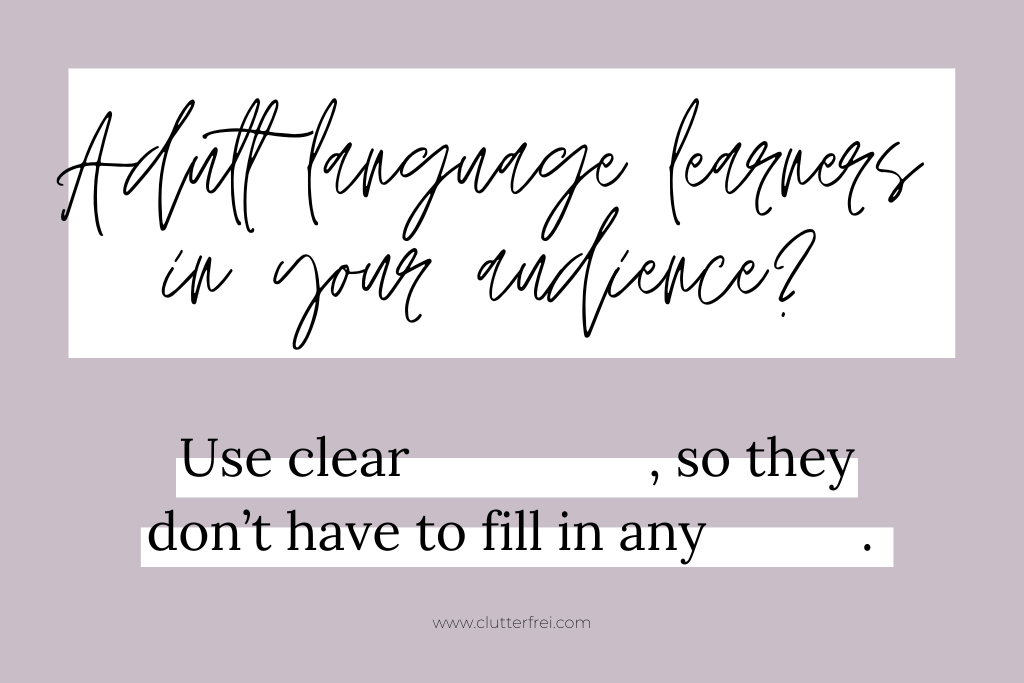
Adult language learners, like me, experience the above scenario to one degree or another every day. In the US there are about 68 Million speak a language other than English at home, which means 1 in 5 people are non-native speakers.
In this article, we will identify what exactly a non-native speaker is, and how you can improve the learning experience of adult language learners by using plain language principles in your presentation.
A non-native English speaker is a person, who learned English later in life as a second language. For example, I grew up in Germany and my native language is German. At 10 years old I started learning English. That makes me a non-native English speaker.
Of course not every person who learned English as a second or third language has the same level of English proficiency. Adult language learners may have learned English for a long time or may have just started. To measure how proficient the English of different individuals is, there are different frameworks to help you out, like the Common European Framework of Reference for Language (CEFR).
For example
Finish reading here: https://clutterfrei.com/how-a-good-presentation-structure-tremendously-benefits-your-non-native-speakers/
Wenn du den Blog-Artikel magst dann klicke auf das Herz. Das hilft uns zu verstehen, welche Artikel besonders lesenswert sind.