


eduki Qualität
74 Seiten
eduki Qualität
12 Seiten
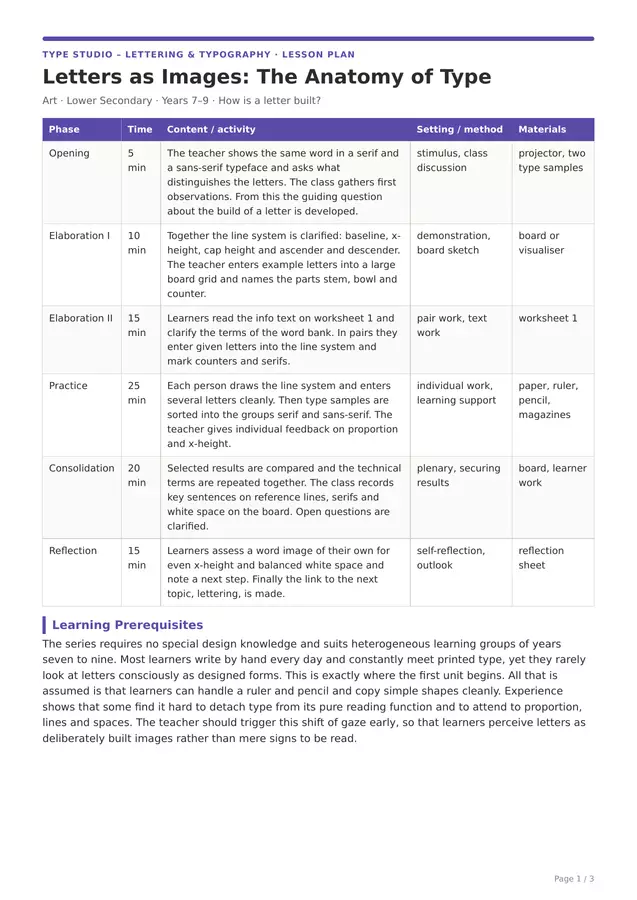
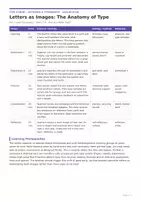
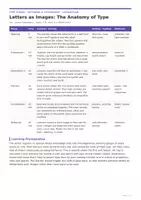
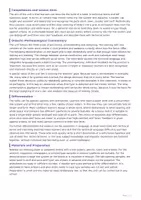
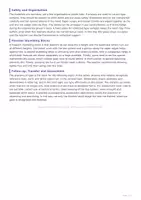
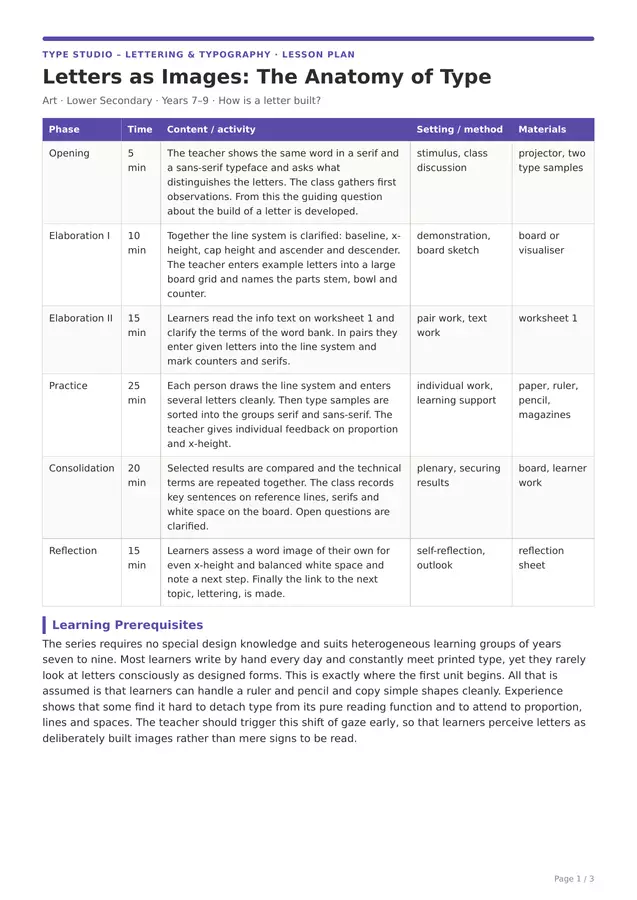


Typography and Visual Communication: three connected English-language Art units for Grades 7–9. Nine worksheets connect explanations, subject vocabulary and practical tasks with observation, analysis and reflection. Each unit has its own teacher plan, detailed expected outcomes and classroom presentation, so teachers can select a topic or use the workshop sequence together.
Letters as Images: The Anatomy of Type
The Reference Lines: Baseline, x-Height & Co.: You can name the most important reference lines and parts of a letter.
Serif or Not? Telling Typefaces Apart: You can distinguish serif and sans-serif typefaces and describe their effect.
Proportion and White Space: Letters in Balance: You can shape letter widths and spacing so that a balanced word image arises.
Lettering & Decorative Type
Basics of Hand Lettering: Upstroke and Downstroke: You can draw expressive letters with thin upstrokes and thick downstrokes.
Decorative Type: Serifs, Flourishes and Ornaments: You can design letters with serifs, flourishes and ornaments without losing legibility.
Composing a Word: Expression and Interplay: You can design a word so that form and meaning fit together.
The Poster: Type That Works
Typographic Hierarchy: The Important Thing First: You can order information by importance and build a clear hierarchy with type size.
Legibility and Contrast: Working from a Distance: You can choose and set type so that it is easy to read even from a distance.
Layout and Eye Guidance: Designing the Poster: You can design a poster with a clear arrangement and deliberate eye guidance.
Nine worksheets with explanatory texts, vocabulary and differentiated tasks.
Three teacher lesson plans with prerequisites, competencies, suggested phases, methodology, differentiation and preparation notes.
Three detailed answer and expected-outcome documents.
Three classroom slide decks.
One combined printable PDF and a separate archive containing editable text documents and presentations.
Introduce a visual example or practical question, establish the key terms and let learners test a small idea before developing a more considered response. Ask pupils to explain how a choice affects the result. Short partner discussions and work reviews can connect making with analysis, while the expected outcomes provide concrete criteria for feedback on both written and practical work.
Letters as Images: The Anatomy of Type: Needed are drawing paper or prepared sheets with a line system, pencils, rulers and erasers. For the analysis magazines, newspapers or printed type samples in various typefaces are suitable.
Lettering & Decorative Type: Needed are paper, pencils, erasers and fineliners or thin felt pens for the final drawing. Where available, brush pens can be added but are not necessary, since faux calligraphy works with any pen.
The Poster: Type That Works: Needed are paper in a uniform format, pencils, rulers, erasers and coloured pens or markers for the contrast. For the scribbles simple layout paper is enough, for the worked-out draft firmer drawing paper.
The school provides practical equipment and materials and selects the visual examples needed for analysis. A separate licensed collection of photographs or artwork reproductions is not included. Read the preparation and organisation notes before the activity, plan workspace and storage where needed, and adjust the amount of support to prior experience. Editable files allow prompts and examples to be adapted to the class.
Which language is included? This is the English edition; German files are not included. Are answers provided? Detailed sample answers and expected outcomes accompany each unit. Can I edit the material? Worksheets, plans, answer guidance and slides are included in editable form in the separate archive. Can units be used individually? Each has a complete set of the teaching files described above.
Source and tool notes from the supplied material are retained. Texts, tasks, answers and design were generated with AI, as declared in the listing. PDF versions of the slides are included in the combined page count; identical editable versions are not counted twice.
Download size: 72 pages in the combined PDF. Slide pages are included in this count. The editable archive contains 15 text documents and 3 slide decks.
Visual Communication: Photography, Digital Images, Posters and Street Art: this bundle contains 4 complete teaching resources with 290 PDF pages in total. Art Grades 7–9. All included resources are the English-language editions. They can be taught separately or selected to build a connected sequence around the named topics.Use the individual packs to introduce concepts, practise subject vocabulary, compare examples and support written or practical outcomes. Select tasks according to learners’ prior knowledge and the level stated in each resource; the bundle is a collection of the listed complete products, rather than a newly sequenced textbook or a promise that every task suits every grade.Which resources are included?Art Grades 7–9: Photography: Composition, Viewpoint and Light | 9 Worksheets & Answers | English Edition · 73 pagesPhotography: Composition, Viewpoint and Light: three connected English-language Art units for Grades 7–9. Nine worksheets connect explanations, subject vocabulary and practical tasks with observation, analysis and reflection. Each unit has its own teacher plan, detailed expected outcomes and classroom presentation, so teachers can select a topic or use the workshop sequence together.Introduce a visual example or practical question, establish the key terms and let learners test a small idea before developing a more considered response. Ask pupils to explain how a choice affects the result. Short partner discussions and work reviews can connect making with analysis, while the expected outcomes provide concrete criteria for feedback on both written and practical work.Digital Image Editing: Pixels, RGB, Layers, Filters and Image Ethics | Art Grades 7–9 | English Edition · 73 pagesDigital Image Editing: three connected English-language Art units for Grades 7–9. Nine worksheets connect explanations, subject vocabulary and practical tasks with observation, analysis and reflection. Each unit has its own teacher plan, detailed expected outcomes and classroom presentation, so teachers can select a topic or use the workshop sequence together.Introduce a visual example or practical question, establish the key terms and let learners test a small idea before developing a more considered response. Ask pupils to explain how a choice affects the result. Short partner discussions and work reviews can connect making with analysis, while the expected outcomes provide concrete criteria for feedback on both written and practical work.Typography, Hand Lettering and Poster Design | Art Grades 7–9 | 9 Worksheets & Answers | English Edition · 72 pagesTypography and Visual Communication: three connected English-language Art units for Grades 7–9. Nine worksheets connect explanations, subject vocabulary and practical tasks with observation, analysis and reflection. Each unit has its own teacher plan, detailed expected outcomes and classroom presentation, so teachers can select a topic or use the workshop sequence together.Introduce a visual example or practical question, establish the key terms and let learners test a small idea before developing a more considered response. Ask pupils to explain how a choice affects the result. Short partner discussions and work reviews can connect making with analysis, while the expected outcomes provide concrete criteria for feedback on both written and practical work.Art Grades 7–9: Street Art – Stencils, Graffiti Lettering and Visual Messages | English Edition · 72 pagesStreet Art and Public Space: three connected English-language Art units for Grades 7–9. Nine worksheets connect explanations, subject vocabulary and practical tasks with observation, analysis and reflection. Each unit has its own teacher plan, detailed expected outcomes and classroom presentation, so teachers can select a topic or use the workshop sequence together.Introduce a visual example or practical question, establish the key terms and let learners test a small idea before developing a more considered response. Ask pupils to explain how a choice affects the result. Short partner discussions and work reviews can connect making with analysis, while the expected outcomes provide concrete criteria for feedback on both written and practical work.Files, preparation and frequently asked questionsYou receive the complete files of the listed individual products, with the worksheets, answers, teaching notes and presentations described in each listing. File formats and additional preparation vary by resource: consult each included product for its exact inventory. PDF page totals count the complete printable editions, including covers, teaching notes and answers; editable versions are not counted again as extra pages.Preparation requirements and any teacher-provided equipment or media are stated in the individual resources. Review those notes before choosing practical activities.Does this add new worksheets to the individual packs? No. This offer groups the named complete products. If you already own one or more, check the overlap before purchasing. Text, tasks, answers and the supplied cover graphics were fully created with AI. Source references and resource-specific notes are retained in the individual files. The resources have not been classroom tested.Sum of individual prices: 89.96 €. Bundle price: 69.99 € (saving: 22.2%).
Klassenstufen: 7-8. Klasse



Bewertungen und Kommentare