


eduki Qualität
74 Seiten
eduki Qualität
12 Seiten
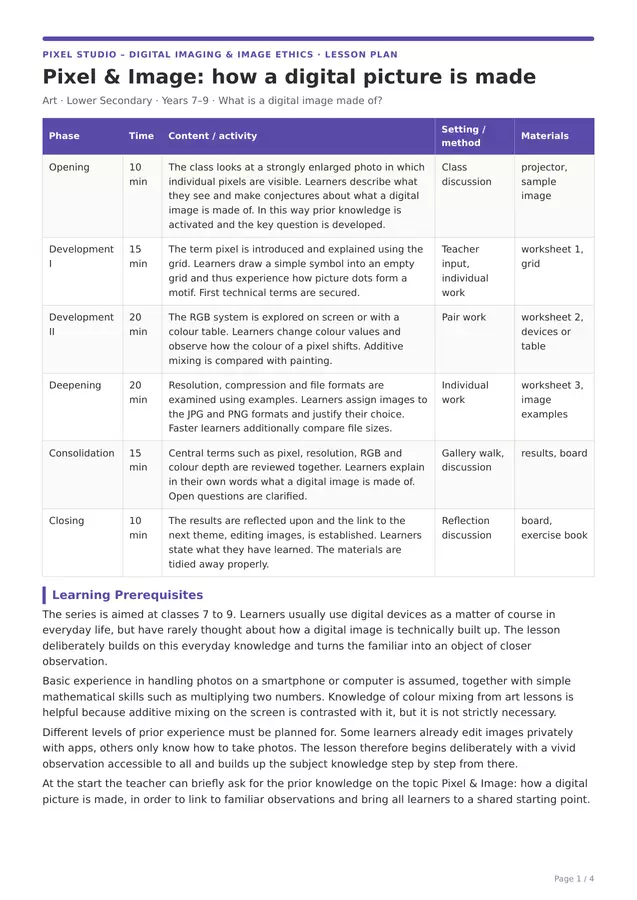


Digital Image Editing: three connected English-language Art units for Grades 7–9. Nine worksheets connect explanations, subject vocabulary and practical tasks with observation, analysis and reflection. Each unit has its own teacher plan, detailed expected outcomes and classroom presentation, so teachers can select a topic or use the workshop sequence together.
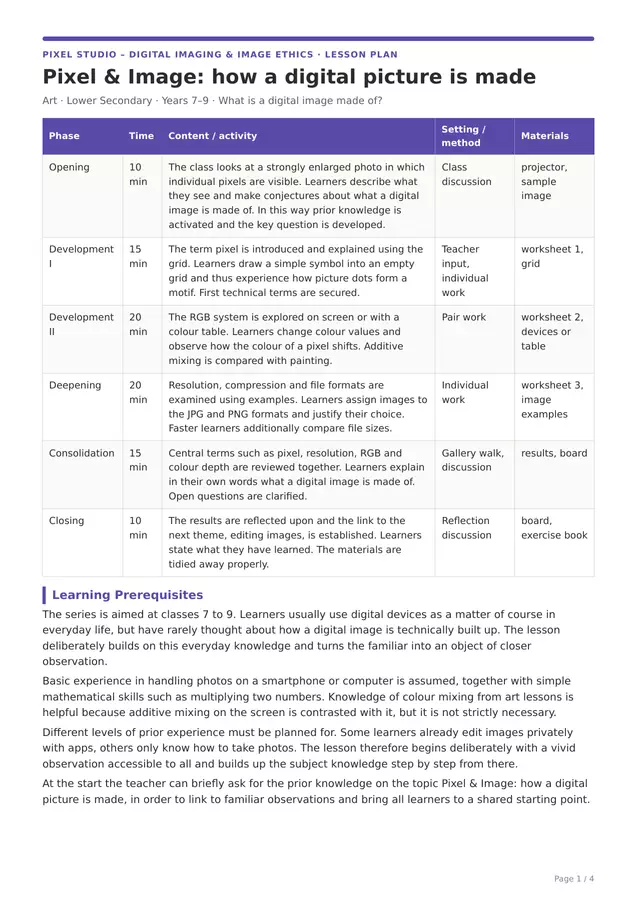
Pixel & Image: how a digital picture is made
The Pixel – the Smallest Building Block: Learners explain that a digital image consists of pixels arranged in a grid and describe the connection between resolution and sharpness.
Colour in the Computer – RGB and Colour Depth: Learners explain how colours on a screen are created from red, green and blue, and describe what colour depth means.
Resolution, File Size and Formats: Learners distinguish common image formats and explain the connection between resolution, compression and file size.
Changing Images: Tools & Effect
Basic Tools: Crop, Brightness, Contrast: Learners use cropping, brightness and contrast deliberately and describe how these tools change the message of an image.
Colour and Mood: Saturation, Filters, White Balance: Learners change colour moods with saturation, filters and white balance and describe their effect on the image.
Layers, Selection and Montage: Learners explain the principle of layers and selection and describe how montage creates new image messages.
Image Ethics: Original, Editing & Truth
Original and Editing: What Is Allowed?: Learners distinguish correction and manipulation and justify when an edit is fair or deceptive.
Images in Advertising and Media: Learners analyse edited images in advertising and media and judge their effect on self-image.
Copyright, Sources and Labelling: Learners explain basic rules of copyright and justify why sources and edits should be labelled.
Nine worksheets with explanatory texts, vocabulary and differentiated tasks.
Three teacher lesson plans with prerequisites, competencies, suggested phases, methodology, differentiation and preparation notes.
Three detailed answer and expected-outcome documents.
Three classroom slide decks.
One combined printable PDF and a separate archive containing editable text documents and presentations.
Introduce a visual example or practical question, establish the key terms and let learners test a small idea before developing a more considered response. Ask pupils to explain how a choice affects the result. Short partner discussions and work reviews can connect making with analysis, while the expected outcomes provide concrete criteria for feedback on both written and practical work.
Pixel & Image: how a digital picture is made: A projector for the enlarged opening image is needed, together with the printed worksheets of the lesson. A prepared, strongly enlarged photo in which individual pixels are clearly visible should be selected and tested in advance.
Changing Images: Tools & Effect: A projector for the image pair in the opening is needed, together with the printed worksheets. A suitable original and a clearly but fairly edited version should be selected and tested in advance.
Image Ethics: Original, Editing & Truth: A projector for the image examples in the opening is needed, together with the printed worksheets. A meaningful news photo and a typical advertisement should be selected in advance and checked for their suitability.
The school provides practical equipment and materials and selects the visual examples needed for analysis. A separate licensed collection of photographs or artwork reproductions is not included. Read the preparation and organisation notes before the activity, plan workspace and storage where needed, and adjust the amount of support to prior experience. Editable files allow prompts and examples to be adapted to the class.
Which language is included? This is the English edition; German files are not included. Are answers provided? Detailed sample answers and expected outcomes accompany each unit. Can I edit the material? Worksheets, plans, answer guidance and slides are included in editable form in the separate archive. Can units be used individually? Each has a complete set of the teaching files described above.
Source and tool notes from the supplied material are retained. Texts, tasks, answers and design were generated with AI, as declared in the listing. PDF versions of the slides are included in the combined page count; identical editable versions are not counted twice.
Download size: 73 pages in the combined PDF. Slide pages are included in this count. The editable archive contains 15 text documents and 3 slide decks.
Visual Communication: Photography, Digital Images, Posters and Street Art: this bundle contains 4 complete teaching resources with 290 PDF pages in total. Art Grades 7–9. All included resources are the English-language editions. They can be taught separately or selected to build a connected sequence around the named topics.Use the individual packs to introduce concepts, practise subject vocabulary, compare examples and support written or practical outcomes. Select tasks according to learners’ prior knowledge and the level stated in each resource; the bundle is a collection of the listed complete products, rather than a newly sequenced textbook or a promise that every task suits every grade.Which resources are included?Art Grades 7–9: Photography: Composition, Viewpoint and Light | 9 Worksheets & Answers | English Edition · 73 pagesPhotography: Composition, Viewpoint and Light: three connected English-language Art units for Grades 7–9. Nine worksheets connect explanations, subject vocabulary and practical tasks with observation, analysis and reflection. Each unit has its own teacher plan, detailed expected outcomes and classroom presentation, so teachers can select a topic or use the workshop sequence together.Introduce a visual example or practical question, establish the key terms and let learners test a small idea before developing a more considered response. Ask pupils to explain how a choice affects the result. Short partner discussions and work reviews can connect making with analysis, while the expected outcomes provide concrete criteria for feedback on both written and practical work.Digital Image Editing: Pixels, RGB, Layers, Filters and Image Ethics | Art Grades 7–9 | English Edition · 73 pagesDigital Image Editing: three connected English-language Art units for Grades 7–9. Nine worksheets connect explanations, subject vocabulary and practical tasks with observation, analysis and reflection. Each unit has its own teacher plan, detailed expected outcomes and classroom presentation, so teachers can select a topic or use the workshop sequence together.Introduce a visual example or practical question, establish the key terms and let learners test a small idea before developing a more considered response. Ask pupils to explain how a choice affects the result. Short partner discussions and work reviews can connect making with analysis, while the expected outcomes provide concrete criteria for feedback on both written and practical work.Typography, Hand Lettering and Poster Design | Art Grades 7–9 | 9 Worksheets & Answers | English Edition · 72 pagesTypography and Visual Communication: three connected English-language Art units for Grades 7–9. Nine worksheets connect explanations, subject vocabulary and practical tasks with observation, analysis and reflection. Each unit has its own teacher plan, detailed expected outcomes and classroom presentation, so teachers can select a topic or use the workshop sequence together.Introduce a visual example or practical question, establish the key terms and let learners test a small idea before developing a more considered response. Ask pupils to explain how a choice affects the result. Short partner discussions and work reviews can connect making with analysis, while the expected outcomes provide concrete criteria for feedback on both written and practical work.Art Grades 7–9: Street Art – Stencils, Graffiti Lettering and Visual Messages | English Edition · 72 pagesStreet Art and Public Space: three connected English-language Art units for Grades 7–9. Nine worksheets connect explanations, subject vocabulary and practical tasks with observation, analysis and reflection. Each unit has its own teacher plan, detailed expected outcomes and classroom presentation, so teachers can select a topic or use the workshop sequence together.Introduce a visual example or practical question, establish the key terms and let learners test a small idea before developing a more considered response. Ask pupils to explain how a choice affects the result. Short partner discussions and work reviews can connect making with analysis, while the expected outcomes provide concrete criteria for feedback on both written and practical work.Files, preparation and frequently asked questionsYou receive the complete files of the listed individual products, with the worksheets, answers, teaching notes and presentations described in each listing. File formats and additional preparation vary by resource: consult each included product for its exact inventory. PDF page totals count the complete printable editions, including covers, teaching notes and answers; editable versions are not counted again as extra pages.Preparation requirements and any teacher-provided equipment or media are stated in the individual resources. Review those notes before choosing practical activities.Does this add new worksheets to the individual packs? No. This offer groups the named complete products. If you already own one or more, check the overlap before purchasing. Text, tasks, answers and the supplied cover graphics were fully created with AI. Source references and resource-specific notes are retained in the individual files. The resources have not been classroom tested.Sum of individual prices: 89.96 €. Bundle price: 69.99 € (saving: 22.2%).
Klassenstufen: 7-8. Klasse



Bewertungen und Kommentare