


eduki Qualität
74 Seiten
eduki Qualität
12 Seiten
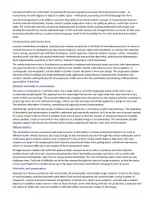


Sculpture and Statuary – Foundations of Analysis: an English-language Art teaching unit for upper secondary, Grades 11–13. How do you describe and analyse a sculpture using technical terms and fixed criteria? The resource connects explanatory reading, subject vocabulary and structured tasks with analysis, interpretation and practical thinking. 5 worksheets are accompanied by detailed answers, a teacher lesson plan and a classroom presentation.
Learning the basic terms: sculpture, statuary, object
Learners distinguish the basic terms sculpture, statuary, object and installation and explain the difference between free-standing sculpture and relief.
Deepening material and technique
Learners match the materials stone, bronze, wood and clay to the appropriate techniques and describe their effect.
Analysing a piece of sculpture
Learners systematically analyse a sculpture according to volume, surface, viewpoints and standing motif.
Interpreting spatial relationship, viewpoints and effect
Learners interpret how spatial relationship, viewpoints, light and location influence the effect of a sculpture.
Designing and justifying your own three-dimensional object
Learners design their own three-dimensional object and justify material, process, form and spatial relationship in technical terms.
The worksheets provide information texts and vocabulary support before learners apply the ideas in tasks. Questions progress from explaining concepts to examining an example, supporting an interpretation and developing a response. Core and optional tasks allow the teacher to select the amount of work and the level of support. The focus is on connecting an observation with evidence and a reasoned explanation.
5 worksheets with explanatory texts, subject vocabulary and differentiated tasks.
A detailed answer and expected-outcome document.
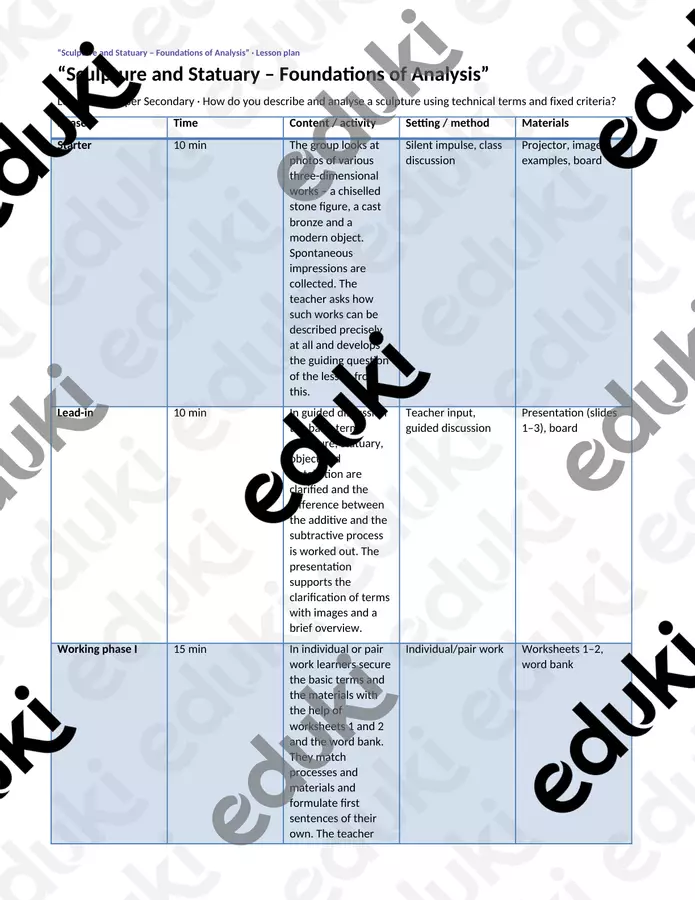
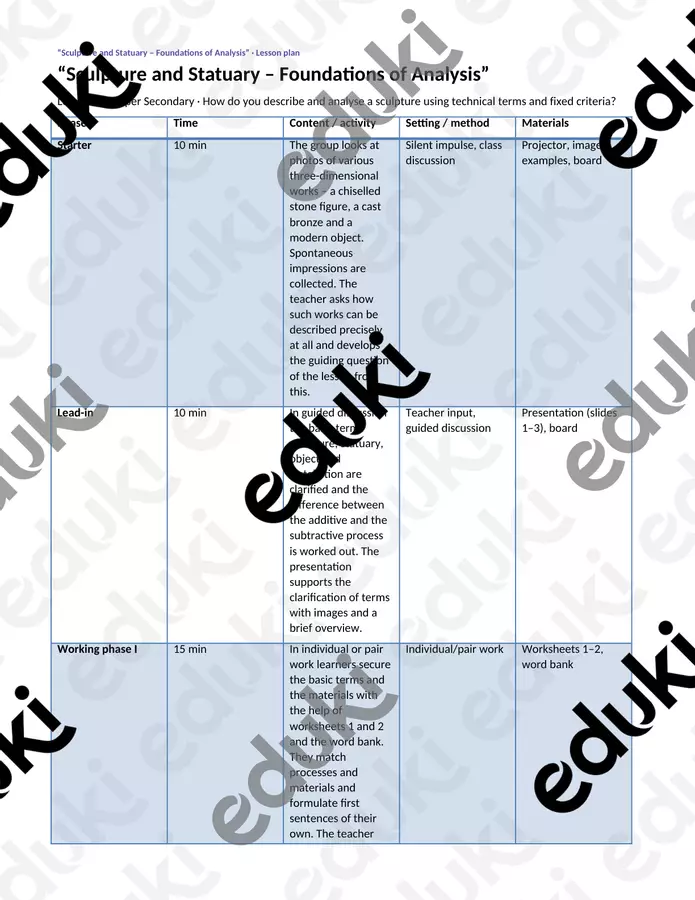
A teacher lesson plan with competencies, suggested phases, didactic and methodological notes, differentiation and preparation.
A classroom slide deck.
One combined printable PDF and a separate archive containing editable text documents and the presentation.
Begin with a selected visual example or question, collect observations and introduce the terms needed for a closer examination. Ask learners to distinguish what they can describe from what they infer, and to support the interpretation with concrete features. Pair discussion can help pupils test an explanation before writing it. The expected outcomes support feedback on written and practical responses and help make the criteria visible.
Required are the five worksheets with word banks, the presentation and suitable image material. Central is the choice of work examples: well-documented works shown from several viewpoints are recommended, so that number of viewpoints, volume and surface become recognisable. A mixture of a classic stone sculpture, a bronze and a modern object or installation makes sense in order to show the basic terms with strong contrast. For projection, a projector and the option to darken the room are helpful so that light effects also become visible on the images. The teacher prepares a board image with the analytical grid (volume, surface, viewpoints, standing motif, light and spatial relationship). For the concluding creative task, paper and drawing materials for the labelled sketch are sufficient; anyone wishing to add a practical realisation keeps clay, mats and simple modelling tools ready. This offer contains the English edition; the German version is not included. A brief review of the selected works before the lesson ensures that the criteria are actually recognisable in the example.
The teacher selects and provides the artwork reproductions, photographs or other visual examples needed for the analysis tasks. These are not supplied as a separate licensed image collection. Practical tools and materials are also provided by the school. Use the editable files to adjust prompts, choose a suitable example and adapt the amount of writing or making time to the class.
Which language is included? This is the English edition; German files are not included. Are answers provided? Yes. Detailed sample answers and expected outcomes accompany the worksheets. Can I edit it? Text documents and the slide deck are supplied in editable form in the separate archive. Which stage is it for? The unit is intended for upper secondary Art; select examples and support according to the course and prior knowledge.
Source and tool notes from the supplied material are retained. Texts, tasks, answers and design were generated with AI, as declared in the listing. PDF versions of the slides are included in the combined page count; identical editable versions are not counted again.
Download size: 25 pages in the combined PDF. Slide pages are included in this count. The editable archive contains 7 text documents and 1 slide deck.
Sculpture and Installation: Bourgeois, Christo, Kusama and Spatial Analysis: this bundle contains 4 complete teaching resources with 101 PDF pages in total. Art Grades 11–13. All included resources are the English-language editions. They can be taught separately or selected to build a connected sequence around the named topics.Use the individual packs to introduce concepts, practise subject vocabulary, compare examples and support written or practical outcomes. Select tasks according to learners’ prior knowledge and the level stated in each resource; the bundle is a collection of the listed complete products, rather than a newly sequenced textbook or a promise that every task suits every grade.Which resources are included?Christo and Jeanne-Claude – Wrapping and concept art | Art Grades 11–13 | 5 Worksheets & Answers | English Edition · 25 pagesChristo and Jeanne-Claude – Wrapping and concept art: an English-language Art teaching unit for upper secondary, Grades 11–13. How do Christo and Jeanne-Claude turn idea, process and public space into art through temporary wrapping? The resource connects explanatory reading, subject vocabulary and structured tasks with analysis, interpretation and practical thinking. 5 worksheets are accompanied by detailed answers, a teacher lesson plan and a classroom presentation.The worksheets provide information texts and vocabulary support before learners apply the ideas in tasks. Questions progress from explaining concepts to examining an example, supporting an interpretation and developing a response. Core and optional tasks allow the teacher to select the amount of work and the level of support. The focus is on connecting an observation with evidence and a reasoned explanation.Louise Bourgeois – Sculpture and Memory | Art Grades 11–13 | 5 Worksheets & Answers | English Edition · 26 pagesLouise Bourgeois – Sculpture and Memory: an English-language Art teaching unit for upper secondary, Grades 11–13. How does Louise Bourgeois make memory and feelings visible through sculpture, material and installation? The resource connects explanatory reading, subject vocabulary and structured tasks with analysis, interpretation and practical thinking. 5 worksheets are accompanied by detailed answers, a teacher lesson plan and a classroom presentation.The worksheets provide information texts and vocabulary support before learners apply the ideas in tasks. Questions progress from explaining concepts to examining an example, supporting an interpretation and developing a response. Core and optional tasks allow the teacher to select the amount of work and the level of support. The focus is on connecting an observation with evidence and a reasoned explanation.Art Grades 11–13: Sculpture Analysis – Material, Volume, Surface and Space | English Edition · 25 pagesSculpture and Statuary – Foundations of Analysis: an English-language Art teaching unit for upper secondary, Grades 11–13. How do you describe and analyse a sculpture using technical terms and fixed criteria? The resource connects explanatory reading, subject vocabulary and structured tasks with analysis, interpretation and practical thinking. 5 worksheets are accompanied by detailed answers, a teacher lesson plan and a classroom presentation.The worksheets provide information texts and vocabulary support before learners apply the ideas in tasks. Questions progress from explaining concepts to examining an example, supporting an interpretation and developing a response. Core and optional tasks allow the teacher to select the amount of work and the level of support. The focus is on connecting an observation with evidence and a reasoned explanation.Art Grades 11–13: Yayoi Kusama – Installation and Repetition | 5 Worksheets & Answers | English Edition · 25 pagesYayoi Kusama – Installation and Repetition: an English-language Art teaching unit for upper secondary, Grades 11–13. How does Yayoi Kusama create the impression of infinity and self-obliteration through repetition, dot and mirroring? The resource connects explanatory reading, subject vocabulary and structured tasks with analysis, interpretation and practical thinking. 5 worksheets are accompanied by detailed answers, a teacher lesson plan and a classroom presentation.The worksheets provide information texts and vocabulary support before learners apply the ideas in tasks. Questions progress from explaining concepts to examining an example, supporting an interpretation and developing a response. Core and optional tasks allow the teacher to select the amount of work and the level of support. The focus is on connecting an observation with evidence and a reasoned explanation.Files, preparation and frequently asked questionsYou receive the complete files of the listed individual products, with the worksheets, answers, teaching notes and presentations described in each listing. File formats and additional preparation vary by resource: consult each included product for its exact inventory. PDF page totals count the complete printable editions, including covers, teaching notes and answers; editable versions are not counted again as extra pages.The art-history and analysis activities require teacher-selected artwork reproductions; no licensed image collection is included.Does this add new worksheets to the individual packs? No. This offer groups the named complete products. If you already own one or more, check the overlap before purchasing. Text, tasks, answers and the supplied cover graphics were fully created with AI. Source references and resource-specific notes are retained in the individual files. The resources have not been classroom tested.Sum of individual prices: 89.96 €. Bundle price: 69.99 € (saving: 22.2%).
Klassenstufen: EF (10./11. Jhg.), Q1 (11./12. Jhg.)



Bewertungen und Kommentare