


eduki Qualität
74 Seiten
eduki Qualität
12 Seiten
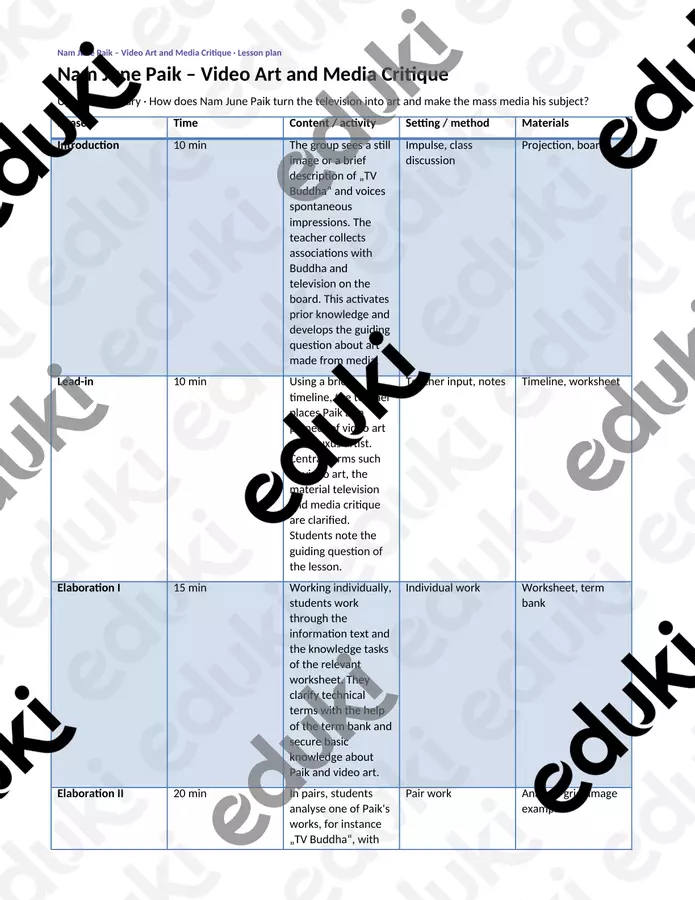
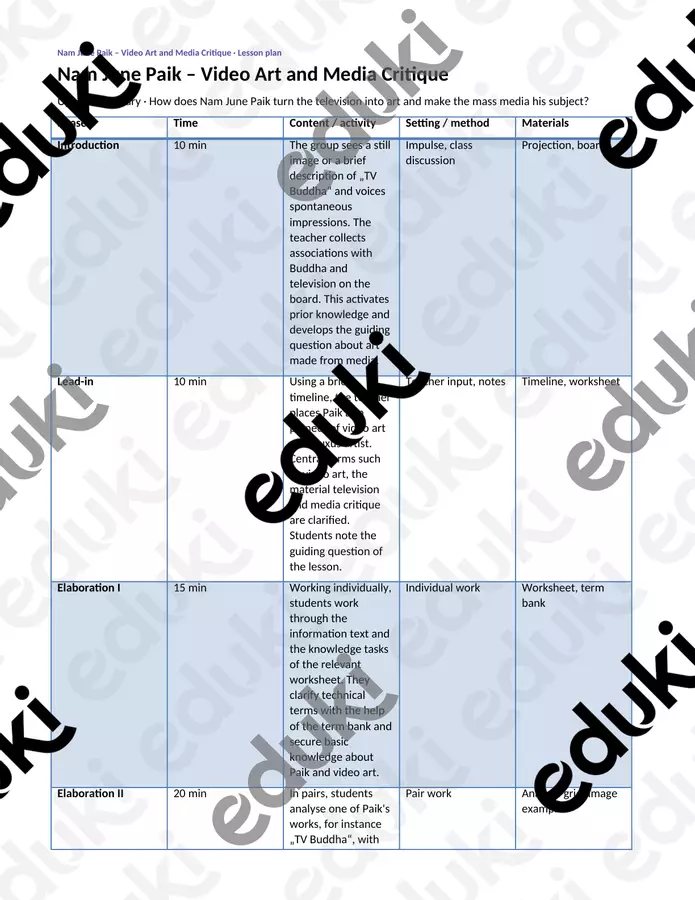


Nam June Paik – Video Art and Media Critique: an English-language Art teaching unit for upper secondary, Grades 11–13. How does Nam June Paik turn the television into art and make the mass media his subject? The resource connects explanatory reading, subject vocabulary and structured tasks with analysis, interpretation and practical thinking. 5 worksheets are accompanied by detailed answers, a teacher lesson plan and a classroom presentation.
Nam June Paik and the Birth of Video Art
Students get to know Nam June Paik as a pioneer of video art and describe how he turned the television set into artistic material.
Fluxus, Media and the Material Television
Students deepen the connection between Paik's work and Fluxus and the mass media and apply key terms to examples.
Work Analysis: „TV Buddha“
Students analyse the work „TV Buddha“ with regard to structure, technique and levels of meaning.
Interpreting Media Critique and Effect
Students interpret and assess Paik's media-critical stance and discuss the effect of his works.
Designing Your Own Media and Video-Art Concept
Students develop and justify their own concept for a media-critical video artwork in the spirit of Paik.
The worksheets provide information texts and vocabulary support before learners apply the ideas in tasks. Questions progress from explaining concepts to examining an example, supporting an interpretation and developing a response. Core and optional tasks allow the teacher to select the amount of work and the level of support. The focus is on connecting an observation with evidence and a reasoned explanation.
5 worksheets with explanatory texts, subject vocabulary and differentiated tasks.
A detailed answer and expected-outcome document.
A teacher lesson plan with competencies, suggested phases, didactic and methodological notes, differentiation and preparation.
A classroom slide deck.
One combined printable PDF and a separate archive containing editable text documents and the presentation.
Begin with a selected visual example or question, collect observations and introduce the terms needed for a closer examination. Ask learners to distinguish what they can describe from what they infer, and to support the interpretation with concrete features. Pair discussion can help pupils test an explanation before writing it. The expected outcomes support feedback on written and practical responses and help make the criteria visible.
Required are the five worksheets with information texts, term banks and tasks, the analysis grid and the presentation slides. For the introduction a projection facility is recommended in order to show a still image or a description of „TV Buddha“ and other works. Board or whiteboard serve for consolidation. For the transfer phase, sketch paper, pens and possibly simple recording devices are helpful if a practical realisation is intended. The teacher should become familiar in advance with the central works, Paik's life dates and the Fluxus movement in order to answer questions confidently. Image material must be checked for copyright; the description of the works in the text makes the series possible even without original illustrations. A timeline facilitates the art-historical classification.
The teacher selects and provides the artwork reproductions, photographs or other visual examples needed for the analysis tasks. These are not supplied as a separate licensed image collection. Practical tools and materials are also provided by the school. Use the editable files to adjust prompts, choose a suitable example and adapt the amount of writing or making time to the class.
Which language is included? This is the English edition; German files are not included. Are answers provided? Yes. Detailed sample answers and expected outcomes accompany the worksheets. Can I edit it? Text documents and the slide deck are supplied in editable form in the separate archive. Which stage is it for? The unit is intended for upper secondary Art; select examples and support according to the course and prior knowledge.
Source and tool notes from the supplied material are retained. Texts, tasks, answers and design were generated with AI, as declared in the listing. PDF versions of the slides are included in the combined page count; identical editable versions are not counted again.
Download size: 25 pages in the combined PDF. Slide pages are included in this count. The editable archive contains 7 text documents and 1 slide deck.
Pop Art and Media: Warhol, Höch, Paik and Graphic Novels: this bundle contains 4 complete teaching resources with 96 PDF pages in total. Art Grades 11–13. All included resources are the English-language editions. They can be taught separately or selected to build a connected sequence around the named topics.Use the individual packs to introduce concepts, practise subject vocabulary, compare examples and support written or practical outcomes. Select tasks according to learners’ prior knowledge and the level stated in each resource; the bundle is a collection of the listed complete products, rather than a newly sequenced textbook or a promise that every task suits every grade.Which resources are included?Art Grades 11–13: Andy Warhol – Pop Art and seriality | 3 Worksheets & Answers | English Edition · 20 pagesAndy Warhol – Pop Art and seriality: an English-language Art teaching unit for upper secondary, Grades 11–13. Why does Andy Warhol repeat images from consumption and celebrity – and what does that say about art and the world of goods? The resource connects explanatory reading, subject vocabulary and structured tasks with analysis, interpretation and practical thinking. 3 worksheets are accompanied by detailed answers, a teacher lesson plan and a classroom presentation.The worksheets provide information texts and vocabulary support before learners apply the ideas in tasks. Questions progress from explaining concepts to examining an example, supporting an interpretation and developing a response. Core and optional tasks allow the teacher to select the amount of work and the level of support. The focus is on connecting an observation with evidence and a reasoned explanation.Graphic Novel and Comic in Art Lessons | Art Grades 11–13 | 5 Worksheets & Answers | English Edition · 25 pagesGraphic Novel and Comic in Art Lessons: an English-language Art teaching unit for upper secondary, Grades 11–13. How do comics and graphic novels tell stories with a visual language of their own, and how do I design an image sequence myself? The resource connects explanatory reading, subject vocabulary and structured tasks with analysis, interpretation and practical thinking. 5 worksheets are accompanied by detailed answers, a teacher lesson plan and a classroom presentation.The worksheets provide information texts and vocabulary support before learners apply the ideas in tasks. Questions progress from explaining concepts to examining an example, supporting an interpretation and developing a response. Core and optional tasks allow the teacher to select the amount of work and the level of support. The focus is on connecting an observation with evidence and a reasoned explanation.Art Grades 11–13: Hannah Höch – Dada Collage | 5 Worksheets & Answers | English Edition · 26 pagesHannah Höch – Dada Collage: an English-language Art teaching unit for upper secondary, Grades 11–13. How does Hannah Höch use the technique of photomontage to make criticism of society, politics and gender roles visible? The resource connects explanatory reading, subject vocabulary and structured tasks with analysis, interpretation and practical thinking. 5 worksheets are accompanied by detailed answers, a teacher lesson plan and a classroom presentation.The worksheets provide information texts and vocabulary support before learners apply the ideas in tasks. Questions progress from explaining concepts to examining an example, supporting an interpretation and developing a response. Core and optional tasks allow the teacher to select the amount of work and the level of support. The focus is on connecting an observation with evidence and a reasoned explanation.Art Grades 11–13: Nam June Paik – Video Art and Media Critique | 5 Worksheets & Answers | English Edition · 25 pagesNam June Paik – Video Art and Media Critique: an English-language Art teaching unit for upper secondary, Grades 11–13. How does Nam June Paik turn the television into art and make the mass media his subject? The resource connects explanatory reading, subject vocabulary and structured tasks with analysis, interpretation and practical thinking. 5 worksheets are accompanied by detailed answers, a teacher lesson plan and a classroom presentation.The worksheets provide information texts and vocabulary support before learners apply the ideas in tasks. Questions progress from explaining concepts to examining an example, supporting an interpretation and developing a response. Core and optional tasks allow the teacher to select the amount of work and the level of support. The focus is on connecting an observation with evidence and a reasoned explanation.Files, preparation and frequently asked questionsYou receive the complete files of the listed individual products, with the worksheets, answers, teaching notes and presentations described in each listing. File formats and additional preparation vary by resource: consult each included product for its exact inventory. PDF page totals count the complete printable editions, including covers, teaching notes and answers; editable versions are not counted again as extra pages.The art-history and analysis activities require teacher-selected artwork reproductions; no licensed image collection is included.Does this add new worksheets to the individual packs? No. This offer groups the named complete products. If you already own one or more, check the overlap before purchasing. Text, tasks, answers and the supplied cover graphics were fully created with AI. Source references and resource-specific notes are retained in the individual files. The resources have not been classroom tested.Sum of individual prices: 94.96 €. Bundle price: 69.99 € (saving: 26.3%).
Klassenstufen: EF (10./11. Jhg.), Q1 (11./12. Jhg.)



Bewertungen und Kommentare