


eduki Qualität
74 Seiten
eduki Qualität
12 Seiten
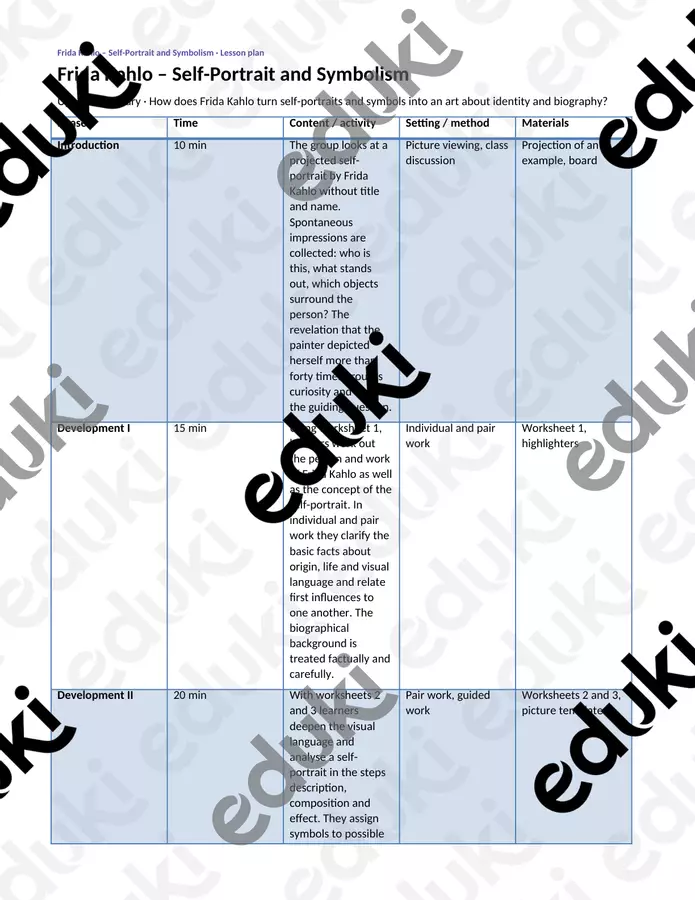
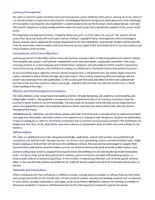
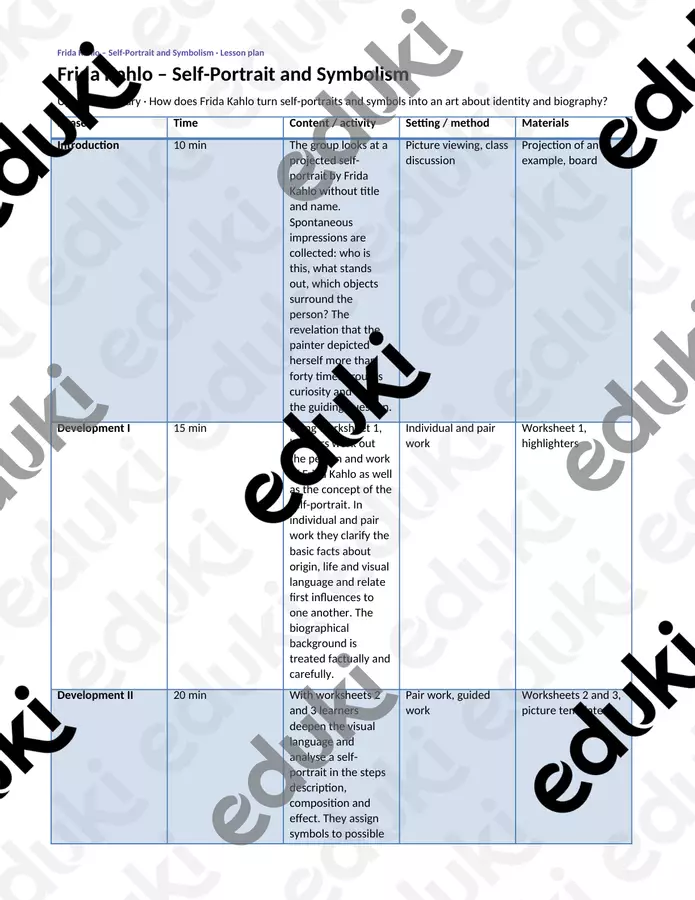


Frida Kahlo – Self-Portrait and Symbolism: an English-language Art teaching unit for upper secondary, Grades 11–13. How does Frida Kahlo turn self-portraits and symbols into an art about identity and biography? The resource connects explanatory reading, subject vocabulary and structured tasks with analysis, interpretation and practical thinking. 5 worksheets are accompanied by detailed answers, a teacher lesson plan and a classroom presentation.
Who was Frida Kahlo?
I get to know Frida Kahlo and her many self-portraits as the starting point of her work.
The visual language of symbols
I deepen my knowledge of recurring symbols and their possible meaning in Kahlo’s self-portraits.
Analysing a self-portrait
I analyse a self-portrait by Frida Kahlo in the steps description, composition and effect.
Interpreting symbolism and identity
I interpret symbolism and identity in Kahlo’s work and assess different readings with justification.
My symbolic self-portrait
I plan and create my own symbolic self-portrait and reflect on my pictorial decisions.
The worksheets provide information texts and vocabulary support before learners apply the ideas in tasks. Questions progress from explaining concepts to examining an example, supporting an interpretation and developing a response. Core and optional tasks allow the teacher to select the amount of work and the level of support. The focus is on connecting an observation with evidence and a reasoned explanation.
5 worksheets with explanatory texts, subject vocabulary and differentiated tasks.
A detailed answer and expected-outcome document.
A teacher lesson plan with competencies, suggested phases, didactic and methodological notes, differentiation and preparation.
A classroom slide deck.
One combined printable PDF and a separate archive containing editable text documents and the presentation.
Begin with a selected visual example or question, collect observations and introduce the terms needed for a closer examination. Ask learners to distinguish what they can describe from what they infer, and to support the interpretation with concrete features. Pair discussion can help pupils test an explanation before writing it. The expected outcomes support feedback on written and practical responses and help make the criteria visible.
What is needed are the five worksheets in sufficient number, suitable picture examples of self-portraits by Frida Kahlo, and a projection facility for the introduction. For the practical creation, drawing and painting material such as coloured or wax crayons, possibly watercolours, and paper are to be provided. Highlighters support the marking of symbols on the picture templates. A board or whiteboard serves for the joint securing of results throughout the lesson. For preparation the teacher selects one or two suitable self-portraits that lend themselves well to description and interpretation, for example a work with clearly recognisable symbols. Image rights are to be observed when using them. It is advisable to work through the sequence of the picture analysis oneself in advance on an example, in order to be able to guide purposefully in class. For the creative part, enough space and time should be planned.
The teacher selects and provides the artwork reproductions, photographs or other visual examples needed for the analysis tasks. These are not supplied as a separate licensed image collection. Practical tools and materials are also provided by the school. Use the editable files to adjust prompts, choose a suitable example and adapt the amount of writing or making time to the class.
Which language is included? This is the English edition; German files are not included. Are answers provided? Yes. Detailed sample answers and expected outcomes accompany the worksheets. Can I edit it? Text documents and the slide deck are supplied in editable form in the separate archive. Which stage is it for? The unit is intended for upper secondary Art; select examples and support according to the course and prior knowledge.
Source and tool notes from the supplied material are retained. Texts, tasks, answers and design were generated with AI, as declared in the listing. PDF versions of the slides are included in the combined page count; identical editable versions are not counted again.
Download size: 26 pages in the combined PDF. Slide pages are included in this count. The editable archive contains 7 text documents and 1 slide deck.
Painting Analysis: Rembrandt, Dürer and Frida Kahlo: this bundle contains 4 complete teaching resources with 109 PDF pages in total. Art Grades 11–13. All included resources are the English-language editions. They can be taught separately or selected to build a connected sequence around the named topics.Use the individual packs to introduce concepts, practise subject vocabulary, compare examples and support written or practical outcomes. Select tasks according to learners’ prior knowledge and the level stated in each resource; the bundle is a collection of the listed complete products, rather than a newly sequenced textbook or a promise that every task suits every grade.Which resources are included?Art Grades 11–13: Albrecht Dürer – self-portrait and printmaking | 5 Worksheets & Answers | English Edition · 32 pagesAlbrecht Dürer – self-portrait and printmaking: an English-language Art teaching unit for upper secondary, Grades 11–13. How did Albrecht Dürer become famous across Europe through self-portrait and printmaking? The resource connects explanatory reading, subject vocabulary and structured tasks with analysis, interpretation and practical thinking. 5 worksheets are accompanied by detailed answers, a teacher lesson plan and a classroom presentation.The worksheets provide information texts and vocabulary support before learners apply the ideas in tasks. Questions progress from explaining concepts to examining an example, supporting an interpretation and developing a response. Core and optional tasks allow the teacher to select the amount of work and the level of support. The focus is on connecting an observation with evidence and a reasoned explanation.Analysing a Painting – Method, Vocabulary and Exam Training | Art Grades 11–13 | 5 Worksheets & Answers | English Edition · 26 pagesAnalysing a Painting – Method, Vocabulary and Exam Training: an English-language Art teaching unit for upper secondary, Grades 11–13. How do you analyse a painting step by step – from description through formal analysis and interpretation to contextualisation? The resource connects explanatory reading, subject vocabulary and structured tasks with analysis, interpretation and practical thinking. 5 worksheets are accompanied by detailed answers, a teacher lesson plan and a classroom presentation.The worksheets provide information texts and vocabulary support before learners apply the ideas in tasks. Questions progress from explaining concepts to examining an example, supporting an interpretation and developing a response. Core and optional tasks allow the teacher to select the amount of work and the level of support. The focus is on connecting an observation with evidence and a reasoned explanation.Art Grades 11–13: Frida Kahlo – Self-Portrait and Symbolism | 5 Worksheets & Answers | English Edition · 26 pagesFrida Kahlo – Self-Portrait and Symbolism: an English-language Art teaching unit for upper secondary, Grades 11–13. How does Frida Kahlo turn self-portraits and symbols into an art about identity and biography? The resource connects explanatory reading, subject vocabulary and structured tasks with analysis, interpretation and practical thinking. 5 worksheets are accompanied by detailed answers, a teacher lesson plan and a classroom presentation.The worksheets provide information texts and vocabulary support before learners apply the ideas in tasks. Questions progress from explaining concepts to examining an example, supporting an interpretation and developing a response. Core and optional tasks allow the teacher to select the amount of work and the level of support. The focus is on connecting an observation with evidence and a reasoned explanation.Rembrandt – Portrait and Chiaroscuro | Art Grades 11–13 | 5 Worksheets & Answers | English Edition · 25 pagesRembrandt – Portrait and Chiaroscuro: an English-language Art teaching unit for upper secondary, Grades 11–13. How does Rembrandt use chiaroscuro and deliberate light direction to create expression and spatial depth in his portraits? The resource connects explanatory reading, subject vocabulary and structured tasks with analysis, interpretation and practical thinking. 5 worksheets are accompanied by detailed answers, a teacher lesson plan and a classroom presentation.The worksheets provide information texts and vocabulary support before learners apply the ideas in tasks. Questions progress from explaining concepts to examining an example, supporting an interpretation and developing a response. Core and optional tasks allow the teacher to select the amount of work and the level of support. The focus is on connecting an observation with evidence and a reasoned explanation.Files, preparation and frequently asked questionsYou receive the complete files of the listed individual products, with the worksheets, answers, teaching notes and presentations described in each listing. File formats and additional preparation vary by resource: consult each included product for its exact inventory. PDF page totals count the complete printable editions, including covers, teaching notes and answers; editable versions are not counted again as extra pages.The art-history and analysis activities require teacher-selected artwork reproductions; no licensed image collection is included.Does this add new worksheets to the individual packs? No. This offer groups the named complete products. If you already own one or more, check the overlap before purchasing. Text, tasks, answers and the supplied cover graphics were fully created with AI. Source references and resource-specific notes are retained in the individual files. The resources have not been classroom tested.Sum of individual prices: 89.96 €. Bundle price: 69.99 € (saving: 22.2%).
Klassenstufen: EF (10./11. Jhg.), Q1 (11./12. Jhg.)



Bewertungen und Kommentare