

−26%
60 Seiten
−26%
70 Seiten


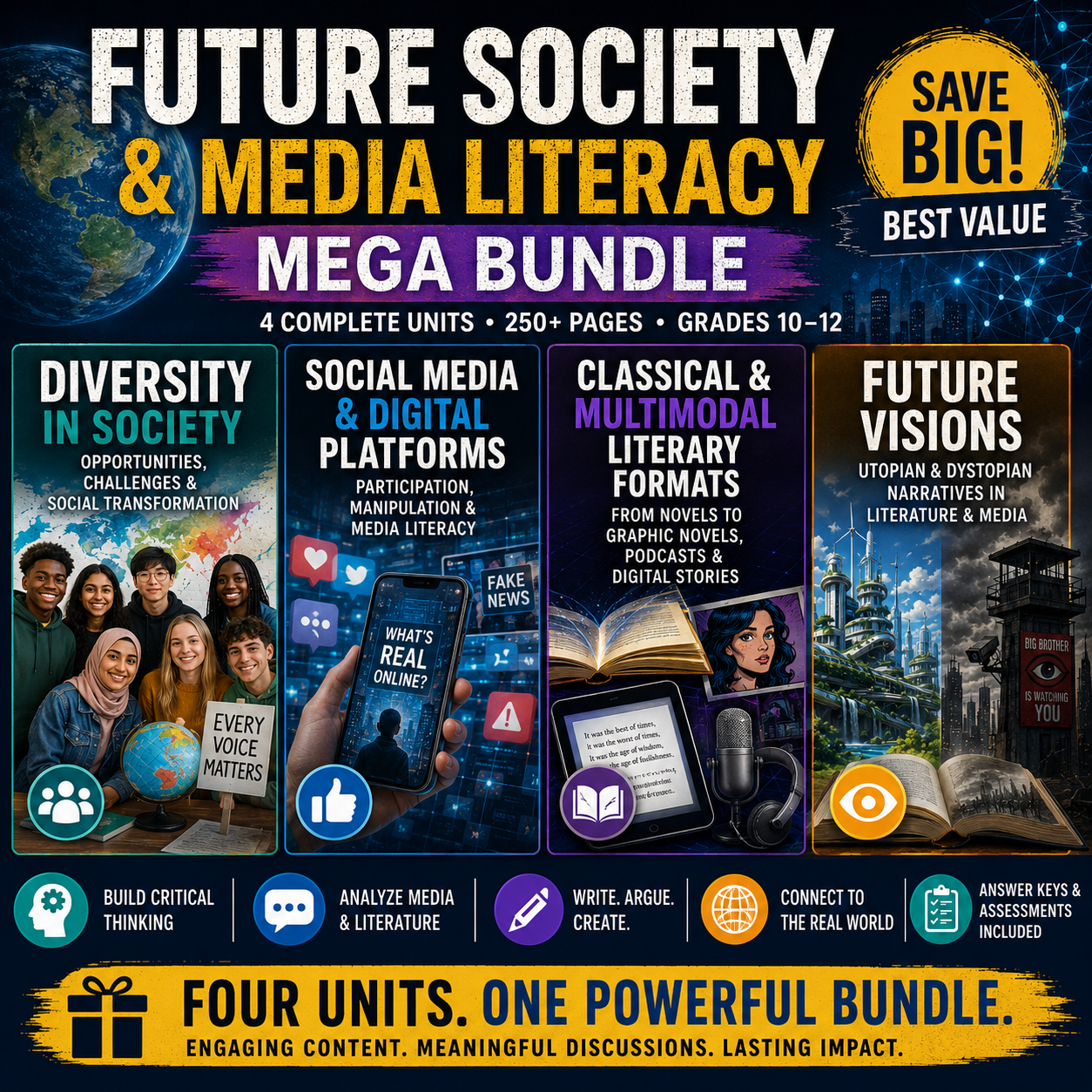
Equip students with the critical thinking skills they need for today's and tomorrow's world. This comprehensive High School English Language Arts bundle combines four engaging interdisciplinary units covering Diversity in Society, Social Media & Digital Platforms, Classical & Multimodal Literary Formats, and Future Visions: Utopian & Dystopian Narratives. Perfect for Grades 10–12, Honors English, AP Literature enrichment, Media Studies, Global Issues, and interdisciplinary humanities.
Prepare students for meaningful discussions about literature, media, identity, technology, and the future with this comprehensive Future Society & Media Literacy Mega Bundle.
Designed specifically for upper secondary English Language Arts classrooms, this bundle brings together four contemporary teaching units that encourage literary analysis, critical thinking, academic discussion, media literacy, and evidence-based writing. Instead of teaching these topics separately, the bundle allows students to explore how literature, society, technology, communication, and identity are deeply interconnected.
Students first examine Diversity in Society, exploring inclusion, identity, equality, equity, migration, social justice, and cultural diversity while strengthening intercultural competence and academic communication.
They then investigate Social Media & Digital Platforms, analyzing algorithms, misinformation, influencer culture, digital participation, artificial intelligence, civic engagement, and media literacy through authentic contemporary examples.
The third unit focuses on Classical & Multimodal Literary Formats, where students compare novels, drama, poetry, graphic novels, digital storytelling, interactive fiction, podcasts, and multimodal communication. Learners discover how literature changes across different media while developing sophisticated literary analysis skills.
Finally, Future Visions: Utopian & Dystopian Narratives encourages students to explore speculative fiction, future societies, technology, surveillance, environmental sustainability, ethics, democracy, and social criticism through literary interpretation and comparative analysis.
Together these four units provide an interdisciplinary curriculum that supports modern English Language Arts instruction while integrating Literature, Media Studies, Cultural Studies, Communication, Global Issues, and Digital Citizenship.
The activities emphasize inquiry-based learning, discussion, literary interpretation, collaborative learning, academic vocabulary, essay writing, presentations, and evidence-based reasoning, making the bundle ideal for semester-long instruction or flexible thematic teaching.
4 complete instructional units
250+ printable classroom pages
Academic reading passages
Literary analysis activities
Media literacy investigations
Comparative literature tasks
Discussion prompts
Inquiry-based learning
Critical-thinking activities
Academic writing tasks
Speaking activities
Essay assignments
Assessment materials
Complete answer keys
Diversity in Society – Opportunities & Challenges
Social Media & Digital Platforms – Participation & Manipulation
Classical & Multimodal Literary Formats
Future Visions – Utopian & Dystopian Narratives
Literary Analysis
Critical Reading
Media Literacy
Digital Citizenship
Academic Vocabulary
Comparative Analysis
Evidence-Based Writing
Discussion Skills
Speaking & Presentation
Argumentative Writing
Intercultural Competence
Critical Thinking
High School English Language Arts
Honors English
AP Literature Enrichment
Media Studies
Global Issues
Humanities
Communication Studies
Grades 10–12
College Preparation
✔ Four highly relevant modern units
✔ Perfect interdisciplinary bundle
✔ Develops 21st-century skills
✔ Excellent literary and media literacy focus
✔ Promotes discussion and debate
✔ Saves extensive planning time
✔ Classroom-ready and easy to implement
✔ Ideal for semester or year-long planning
A complete Grades 10–12 learning unit on diversity in society, covering inclusion, equity, intersectionality, migration, cultural diversity, gender diversity, sexual diversity, disability, discrimination, power structures, and social transformation. Ideal for Civics, Social Studies, Sociology, Global Issues, Ethics, and English-speaking upper secondary classrooms. Full DescriptionThis comprehensive teaching resource helps students critically explore one of the defining topics of modern society: diversity. Instead of presenting diversity as a simple slogan, the unit invites learners to examine its real social complexity, including opportunities, tensions, inequalities, institutional structures, and questions of belonging.Students analyze ethnic, cultural, social, gender, sexual, generational, and ability-related diversity through academic reading passages, real-world examples, structured analytical tasks, and reflective discussion prompts. The unit introduces key concepts such as inclusion, equity, equality, exclusion, intersectionality, structural discrimination, migration, superdiversity, cultural identity, social class, neurodiversity, and power.Designed for upper secondary learners, this resource supports evidence-based discussion rather than opinion-only debate. Students learn to define concepts precisely, compare perspectives, evaluate policies, analyze institutional barriers, and reflect critically on how societies manage difference.The material is especially useful for High School Civics, Social Studies, Sociology, Ethics, Global Issues, ELA discussion units, and interdisciplinary humanities lessons. It can be taught as a complete unit or used flexibly for individual lessons, debates, writing tasks, project work, or exam preparation.What's IncludedComplete teaching unit60 printable pagesAcademic reading passagesReal-world examplesAnalytical worksheetsDiscussion promptsReflection tasksEvaluation activitiesModel answersAnswer key and assessment supportTopics CoveredDiversity in societyInclusion and exclusionEquality and equityIntersectionalityEthnic and racial diversityCultural diversitySocial class and inequalityGender diversitySexual diversityDisability and neurodiversityMigration and superdiversityStructural discriminationInstitutions and powerSocial transformationPerfect ForHigh School CivicsSocial StudiesSociologyEthicsGlobal IssuesELA discussion unitsGrades 10–12AP Government enrichmentInterdisciplinary humanitiesWhy Teachers Love It✔ Relevant and discussion-rich topic✔ Balanced analytical approach✔ Supports critical thinking✔ Includes real-world examples✔ Develops academic argumentation✔ Great for debates, projects, and essays✔ Ready to print and teach
Klassenstufen: Q1 (11./12. Jhg.), Q2 (12./13. Jhg.)
Help students critically examine how social media platforms influence modern society with this engaging High School Civics and Media Literacy resource. Students explore digital participation, algorithms, misinformation, influencers, platform economics, digital identity, online manipulation, and democratic participation through real-world case studies, analytical tasks, and inquiry-based learning. Designed for Grades 10–12, this comprehensive unit strengthens critical thinking, digital citizenship, and media literacy skills. Full DescriptionToday's students spend a significant portion of their lives online, making media literacy and critical digital citizenship more important than ever. This comprehensive instructional unit explores how social media platforms shape communication, public opinion, democracy, identity, and society through evidence-based analysis and engaging classroom activities.Students begin by examining the rise of digital platforms and the transformation of the public sphere. They investigate how algorithms determine what users see, how platform economics are driven by the attention economy, and why digital participation has become a defining characteristic of modern civic life.The resource introduces key concepts such as participation, influence, manipulation, misinformation, algorithmic amplification, echo chambers, filter bubbles, influencer culture, digital identities, and online civic engagement. Learners analyze authentic case studies, evaluate competing perspectives, and develop independent, evidence-based arguments.Throughout the unit, students investigate contemporary issues including fake news, platform governance, digital activism, influencer marketing, privacy, recommendation systems, political communication, digital labor, online polarization, artificial intelligence, and algorithmic decision-making.Structured reading passages, analytical frameworks, higher-order discussion questions, and progressively challenging activities encourage students to evaluate complex issues from multiple perspectives while strengthening academic writing and critical reasoning.Designed for High School Civics, Government, Social Studies, Digital Citizenship, Media Studies, Communication Studies, and interdisciplinary humanities classrooms, this resource provides everything teachers need for engaging and academically rigorous instruction.What's IncludedComplete instructional unitOver 50 printable pagesAcademic reading passagesReal-world case studiesCritical thinking activitiesDiscussion promptsStructured analytical tasksMedia literacy exercisesEvaluation activitiesComplete answer keyTopics CoveredSocial MediaDigital PlatformsDigital ParticipationPublic SphereAlgorithmsAttention EconomyPlatform EconomicsInfluencer CultureFake NewsMisinformationDisinformationMedia ManipulationFilter BubblesEcho ChambersCivic ParticipationDemocracyPolitical CommunicationDigital IdentityOnline CommunitiesDigital CitizenshipArtificial IntelligenceMedia LiteracyPerfect ForHigh School CivicsGovernmentSocial StudiesMedia LiteracyDigital CitizenshipCommunication StudiesSociologyGrades 10–12AP Government EnrichmentInterdisciplinary HumanitiesWhy Teachers Love It✔ Highly relevant contemporary topic✔ Inquiry-based learning✔ Encourages critical thinking✔ Excellent discussion resource✔ Cross-curricular connections✔ Classroom ready✔ Includes complete answer key
Klassenstufen: Q1 (11./12. Jhg.), Q2 (12./13. Jhg.)
Explore the fascinating world of utopian and dystopian fiction through this comprehensive High School English Language Arts resource. Students analyze literary classics, narrative techniques, world-building, symbolism, political systems, technology, and social criticism while developing advanced literary analysis and critical thinking skills. Perfect for Grades 10–12, Honors English, AP Literature enrichment, Media Studies, and Humanities. Full DescriptionHow do writers imagine perfect societies—and why do so many of those dreams become nightmares? This engaging instructional unit invites students to investigate one of literature's most influential genres: utopian and dystopian narratives.Students begin by exploring the origins of utopian thought before examining how authors use imagined societies to critique politics, technology, inequality, environmental issues, surveillance, education, identity, and human nature. Rather than treating these stories as simple works of fiction, learners discover how speculative literature functions as a powerful tool for analyzing real societies.Throughout the unit, students examine the defining characteristics of utopian and dystopian worlds, compare competing visions of ideal societies, analyze historical developments of the genre, and investigate how literary texts reflect cultural hopes and fears. They study concepts such as world-building, narrative perspective, symbolism, ideology, surveillance, propaganda, power structures, freedom, equality, technology, and environmental sustainability.Students also develop advanced literary analysis by exploring narrative techniques, symbolism, characterization, setting, conflict, irony, and perspective. Comparative activities encourage learners to evaluate multiple literary works while discussing ethical questions surrounding democracy, justice, technology, artificial intelligence, environmental responsibility, and social progress.The resource combines rigorous literary scholarship with engaging classroom activities, including analytical reading, structured discussion, comparative writing, evidence-based argumentation, creative responses, and inquiry-based learning.Ideal for High School English Language Arts, Literature, Humanities, Media Studies, Critical Thinking, Global Issues, and interdisciplinary secondary classrooms.What's IncludedComplete instructional unit60+ printable classroom pagesAcademic reading passagesLiterary analysis worksheetsComparative literature activitiesDiscussion promptsCritical thinking tasksEssay writing activitiesCreative response assignmentsAssessment tasksComplete answer keyTopics CoveredUtopian LiteratureDystopian LiteratureLiterary AnalysisNarrative PerspectiveWorld-BuildingSymbolismPolitical SystemsPower and ControlSurveillancePropagandaTechnology and SocietyArtificial IntelligenceEnvironmental FuturesSocial CriticismLiterary GenresComparative LiteratureMedia StudiesCritical ReadingPerfect ForHigh School English Language ArtsLiteratureHonors EnglishAP Literature EnrichmentMedia StudiesHumanitiesGlobal IssuesCritical ThinkingGrades 10–12Why Teachers Love It✔ Contemporary, highly engaging topic✔ Encourages deep literary interpretation✔ Develops analytical writing✔ Strengthens critical thinking✔ Connects literature with real-world issues✔ Perfect for discussion-based learning✔ Ready-to-use classroom resource
Klassenstufen: Q1 (11./12. Jhg.), Q2 (12./13. Jhg.)
Explore how literature evolves across traditional and digital media with this comprehensive High School Literature and Media Studies resource. Students compare novels, drama, poetry, audiobooks, digital storytelling, social media literature, interactive narratives, and multimodal texts while strengthening literary analysis, media literacy, and critical thinking. Ideal for Grades 10–12, English Language Arts, Literature, Media Studies, and interdisciplinary humanities courses. Full DescriptionLiterature is constantly evolving. While novels, poetry, and drama remain essential literary forms, today's students also encounter storytelling through digital media, social platforms, podcasts, interactive fiction, graphic narratives, and multimedia texts. This comprehensive instructional resource helps students understand how literary communication changes when media change.Students investigate both classical literary genres and contemporary multimodal formats through engaging reading passages, comparative analyses, structured inquiry tasks, and higher-order discussion activities. Throughout the unit, they explore how media shape interpretation, audience engagement, authorship, and literary meaning.The resource introduces major literary genres before expanding toward multimodal storytelling. Students compare printed novels with digital narratives, analyze poetry across traditional and social media environments, examine dramatic texts alongside audiovisual adaptations, and evaluate how images, sound, animation, and interaction influence literary interpretation.Key concepts include multimodality, mediality, narrative perspective, reader reception, literary quality, digital transformation, platform culture, attention economy, interactivity, media convergence, and digital literacy. Students learn to distinguish between medium and message while critically evaluating how literary works change when transferred into different media formats.Numerous comparative activities encourage learners to evaluate opportunities and limitations of classical and multimodal literature. Structured analytical writing, classroom debates, creative transfer tasks, and evidence-based discussions develop advanced literary interpretation and media literacy skills.This classroom-ready resource supports interdisciplinary teaching across English Language Arts, Literature, Media Studies, Digital Literacy, Communication Studies, and Humanities while preparing students for higher-level literary analysis and academic writing.What's IncludedComplete instructional unit60+ printable classroom pagesAcademic reading passagesLiterary analysis activitiesComparative media studies tasksCritical thinking exercisesDiscussion promptsCreative transfer activitiesAssessment tasksComplete answer keysTopics CoveredClassical LiteratureNovelsDramaPoetryLiterary AnalysisMultimodal LiteratureDigital StorytellingGraphic NarrativesInteractive FictionAudiobooksSocial Media LiteratureMedia TransformationReader ReceptionNarrative PerspectiveLiterary QualityMedia LiteracyAttention EconomyCommunication StudiesPerfect ForHigh School LiteratureEnglish Language ArtsMedia StudiesDigital LiteracyCommunication StudiesHumanitiesGrades 10–12Honors EnglishAP Literature EnrichmentWhy Teachers Love It✔ Highly relevant contemporary topic✔ Combines literature and media literacy✔ Inquiry-based learning✔ Promotes higher-order literary analysis✔ Excellent classroom discussions✔ Ready-to-print resource✔ Supports interdisciplinary teaching
Klassenstufen: Q1 (11./12. Jhg.), Q2 (12./13. Jhg.)



Bewertungen und Kommentare