


3 Materialien
49 Seiten




How do cells age?
Why can cancer cells divide indefinitely?
What would a 150-year lifespan mean for society?
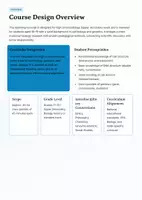
This comprehensive teaching concept provides a fully structured upper secondary biology unit integrating molecular biology, cancer research, aging science, and bioethics.
✔ 8 progressive modules
✔ Approx. 24 structured lessons
✔ Differentiation pathways (basic & advanced level)
✔ Debate format with role cards
✔ Assessment suggestions (AFB I–III equivalent)
✔ Misconception analysis & conceptual change strategy
✔ Model-based learning
✔ Case studies (HeLa cells, Nobel Prize discovery)
✔ Ethical reflection framework
Cell cycle regulation
DNA replication & end-replication problem
Telomere biology & Hayflick limit
Telomerase mechanism
Cancer & cellular immortality
Anti-aging research strategies
Senolytics, mTOR & epigenetic reprogramming
Ethical implications of lifespan extension
Upper Secondary Biology
Advanced Molecular Biology Units
Aging & Cancer Curriculum Blocks
Interdisciplinary Science & Ethics Courses
This teaching concept promotes scientific literacy, critical thinking, and ethical reasoning at an advanced academic level.
This complete bundle provides a fully structured and academically rigorous teaching sequence on telomeres, aging, cancer biology, and ethical implications. Included: ✔ Structured presentation ✔ Comprehensive worksheet package ✔ Full 24-lesson teaching concept ✔ Differentiation pathways ✔ Debate format with role cards ✔ Assessment framework ✔ Misconception analysis Scientific Focus Cell cycle regulation DNA replication & telomere shortening Telomerase mechanism Cancer cell immortality Anti-aging research strategies Ethical reflection on lifespan extension Perfect For Upper Secondary Biology Advanced Molecular Biology Aging & Cancer Units Interdisciplinary Science Courses This bundle supports deep conceptual understanding and scientific reasoning.
Klassenstufen: EF (10./11. Jhg.), Q1 (11./12. Jhg.)



Bewertungen und Kommentare