


−26%
60 Seiten
−26%
70 Seiten




Note: All included resources are also available as individual products.
This complete teaching bundle combines teaching material, lesson planning, and presentation into a coherent CLIL-ready unit on spatial relationships in three-dimensional space. It covers all key configurations between lines and planes using a clear and systematic analytical approach.
The guiding idea is to develop a reliable analytical strategy for classifying spatial relationships. Students learn to solve systems of equations, interpret vector-based results, and explain geometric relationships using precise mathematical language.
Teaching Concept / Lesson Plan
Structured unit planning
Competence-based learning objectives
Differentiation and scaffolding for CLIL
Teaching Material
Line–line, line–plane, plane–plane relationships
Investigation schemes and exam-oriented tasks
Presentation
Visual overview of all spatial relationships
Step-by-step decision strategies
Support for introduction, practice, and revision
CLIL mathematics courses
Upper secondary bilingual programs
Analytic geometry units
Exam preparation and revision
Upper secondary students, CLIL math instruction, bilingual education
Bilingualer Mathe-Unterricht, spatial relationships, analytic geometry, lines and planes, CLIL math
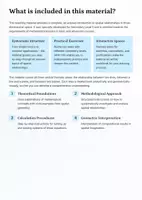
This presentation provides a structured and comprehensive introduction to spatial relationships in three-dimensional space. It covers all key relationships between lines and planes and is specifically designed for bilingual (CLIL) mathematics instruction. Didactic Aim / Guiding Idea The guiding idea is to develop a systematic analytical approach to classifying spatial relationships. Students learn to apply clear algorithms, solve linear systems, and interpret geometric results using precise mathematical language. Contents & Key Topics spatial relationships in analytic geometry overview of all possible configurations line–line relationships parallel, intersecting, identical, skew lines line–plane relationships plane–plane relationships solving linear systems distance and angle calculations common mistakes and exam strategies Classroom Use CLIL mathematics courses Upper secondary bilingual programs Analytic geometry units Exam preparation and revision Best for Upper secondary students, CLIL math instruction, bilingual education Keywords Bilingualer Mathe-Unterricht, spatial relationships, lines and planes, analytic geometry, CLIL math
Klassenstufen: EF (10./11. Jhg.), Q1 (11./12. Jhg.)
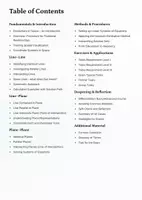
This classroom-ready teaching resource provides a comprehensive and structured introduction to spatial relationships in three-dimensional analytic geometry. It covers all essential configurations between lines and planes: line–line, line–plane, and plane–plane relationships. The material guides students from prerequisite knowledge (vectors, parametric equations, planes, and systems of linear equations) toward a systematic analytical approach for identifying and interpreting spatial relationships. Each case is developed step by step, ensuring students understand both the algebraic procedures and their geometric meaning. A particular strength of this resource is its focus on conceptual clarity. Common misconceptions—such as confusing parallel and skew lines or misinterpreting inconsistent systems—are explicitly addressed. Clear investigation schemes, worked examples, and structured explanations help students develop reliable problem-solving strategies. The resource is suitable for upper secondary mathematics courses, including advanced tracks. It supports both classroom instruction and independent study, making it ideal for introduction, practice, revision, or exam preparation. Teachers benefit from a ready-to-use, logically sequenced teaching material that emphasizes mathematical reasoning, spatial visualization, and exam-relevant competencies.
Klassenstufen: EF (10./11. Jhg.), Q1 (11./12. Jhg.)
This classroom resource for upper secondary mathematics provides a clear and structured introduction to spatial relationships in three-dimensional analytic geometry. It is fully suitable for bilingual (CLIL) math instruction and supports content learning alongside precise mathematical language. Students systematically analyze all core cases: line–line, line–plane, and plane–plane relationships. The material develops a consistent investigative strategy based on vectors, parametric equations, plane equations, and linear systems, while always linking algebraic results to geometric interpretation in space. Conceptual understanding is emphasized throughout. Common misconceptions—such as confusing parallel and coincident objects or misinterpreting inconsistent systems—are addressed explicitly. Carefully scaffolded explanations, structured examples, and graduated practice tasks support both content mastery and academic language development. The resource is suitable for advanced secondary courses, exam preparation, and bilingual classrooms where mathematical reasoning and subject-specific language accuracy are equally important. Keywords Bilingualer Mathe-Unterricht, spatial geometry, lines and planes, analytic geometry, CLIL mathematics, upper secondary math
Klassenstufen: EF (10./11. Jhg.), Q1 (11./12. Jhg.)



Bewertungen und Kommentare