

16 Σελίδες
4 Σελίδες
4 Σελίδες


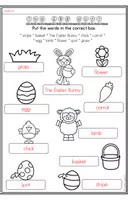


This activity to practise verbs and the present continuous will get your students out of their seats, moving around, as well as bringing some Easter fun to the classroom.There are 2 levels.Level 1 - Find it!Hang up the cards around the room.Give each student a worksheetStudents read the sentences on their worksheet, and walk around the room to find the matching picture. When they find it, they write the number of the picture next to the sentence.Level 2 - Write it!Hang up the cards around the room. Give each student a worksheetStudents walk around the room and find the picture which has the same number as on their worksheet. They look at the picture and write down what the Easter Bunny is doing. There are also flashcards and a worksheet to help you present the actions before you start the activity. There are 2 different versions of the flashcards, infinitive or gerund.
Τάξεις: Ε' Δημοτικού, ΣΤ' Δημοτικού
This booklet has a variety of fun Easter exercises for pupils to do. (If you print the booklet double-sided, you only need two pieces of paper per pupil.)
Τάξεις: Ε' Δημοτικού, ΣΤ' Δημοτικού
This fun chain game is a great way to practise Easter vocabulary.How to play:Divide the cards between the students. The person with the first card begins.A: 'I have the first card. Who has the nest?'B: 'I have the nest. Who has the basket?'C: 'I have the basket. Who has the rabbit?'The game continues like this until the last card.This game is a quick way to learn vocabulary and to practise pronunciation.Tip: Use a stopwatch and see how fast your students can get to the end. Each time they play, they should try to beat their record.
Τάξεις: Ε' Δημοτικού, ΣΤ' Δημοτικού
This set is based around 30 irregular verbs.There are fun egg puzzles for the students to match the infinitive and the simple past. (colour and black & white)There are worksheets for the students to practise the verb forms.There are 8 task cards for the students to practise positive and negative sentences, questions, word order and more!
Τάξεις: Ε' Δημοτικού, ΣΤ' Δημοτικού




Αξιολογήσεις και σχόλια