


2 páginas
4 páginas
1 página


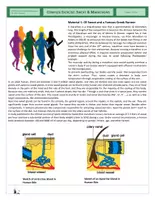
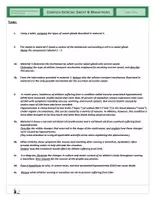
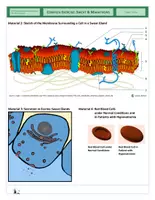


This document contains a complex exercise on cells which focuses on membranes and transport processes involving biological membranes. This knowledge is applied to the exercise-associated hyponatremia - a condition which sometimes occurs in athletes.
The exercise is tailored to require 90 min of work when done in "one sitting" and in writing.
It includes the solutions and references to the following competencies:
- I can purposefully extract information from written sources.
- I can display similarities and differences of circumstances, objects, organisms or processes in a tabular manner.
- I can draw conclusions based on known facts and/or data in order to answer a biological question.
- I can trace back a circumstance to a causal correlation.
- I can form justifies hypotheses on scientific questions.
- I can use models to give a justified statement on a biological phenomenon.
- I can evaluate the pros and cons to a question.
- I can depict data in a suitable diagram.
- The students know cells are enclosed within semipermeable membranes which regulate their interaction with their environment.
- I can describe the structure of cell organelles visible with an electron microscope, and I can name their constituents.
- I can describe the structure of important biological macromolecules.
- I can describe passive and active transport processes through the cell membrane, and I can name examples for these processes.
- I can describe membrane-regulated transport processes within the cell, and I can name examples for these processes.
- I can explain the difference between diffusion and osmosis.
- Using specific examples, I can explain the importance of transport processes for the survival and functionality of a cell.




Valoraciones y comentarios