73 páginas
10 páginas


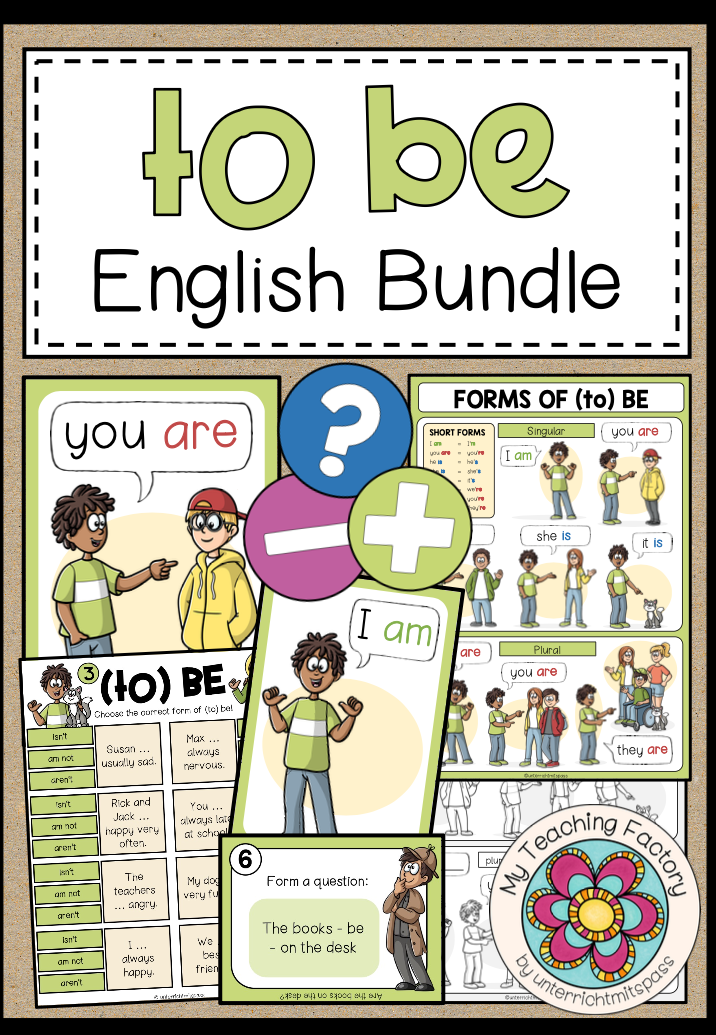
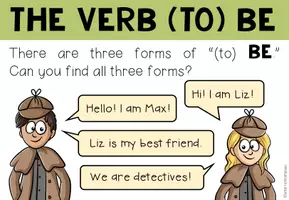
This bundle is a comprehensive collection on the topic of “to be”, specifically designed for use in beginner lessons. The focus is on introducing, reinforcing, and applying the forms of “to be” in positive sentences, negations, questions, and short answers.

The bundle offers a wide variety of well-coordinated materials suitable for both structured grammar instruction and the development of practical language skills. The included worksheets are built up step-by-step and support differentiated as well as independent student work.

Included are, among other things:
This material package is perfect for use in regular English lessons, for differentiation, or as a basis for learning stations. Teachers receive a complete, classroom-tested collection for a varied and student-centred approach to teaching personal pronouns.
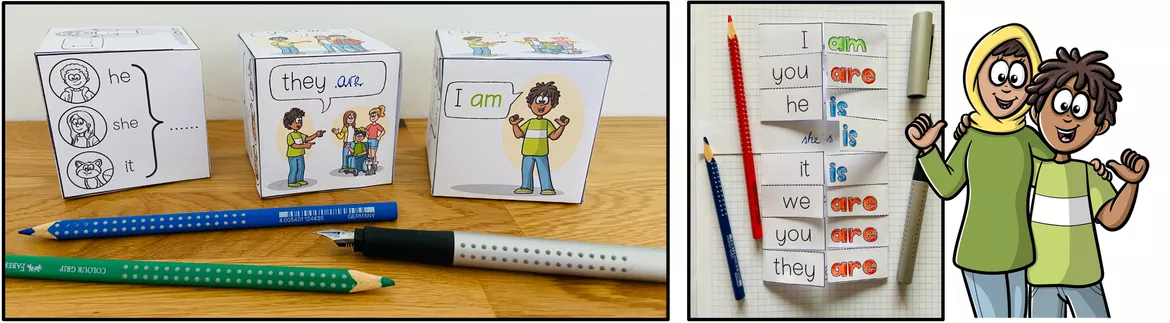
This material is a handy flipbook about the verb “to be,” which students can glue directly into their notebooks. It creatively illustrates what short forms or contractions are and helps learners practise and consolidate them in a structured way. Students cut out the flipbook, fold it, and stick it onto the designated space in their notebooks. On the inside, under each flap, they write the correct short forms, for example: I am → I’m. The flipbook can then be used as a personal learning aid and reference tool, allowing students to keep the short forms of the verb “to be” easily accessible at all times.
Curso: 4.-5. PRIM
This material includes various dice related to the topic “to be,” allowing children to create sentences in a playful way. Different versions of the dice are provided: coloured, black-and-white, pre-filled, and blank for students to fill in themselves. When rolling the dice, simple sentence beginnings such as I am, you are, or he is appear, helping children practise grammar and form correct sentences.In addition, there is a symbol dice that makes the “sentence building” activity more varied. It shows symbols for positive sentences (plus), negative sentences (minus), and questions (question mark). Students can use it to decide what type of sentence to form with the rolled subject and the correct form of to be.Example: If a child rolls “she is” and then the minus symbol, the sentence is: She isn’t happy. If the question mark is rolled, the sentence becomes: Is she happy?The children can make up suitable adjectives for their sentences themselves, or the teacher can write a selection of adjectives such as happy, hungry, tired, etc. on the board for them to choose from.This material is ideal for pair or group work, learning stations, and independent learning phases. It playfully supports the development of confident sentence structures using the verb ”to be”.
Curso: 4.-5. PRIM
This grammar game has been specially designed to practise the verb “to be.” The task cards cover various exercise types related to “to be” and help learners use it confidently in positive sentences, negatives, and questions. The game is perfect for independent learning, learning stations, or remedial lessons and makes grammar practice fun and motivating.The children can play in pairs or small groups. The tasks on the cards can be completed either orally or in writing. Each card also includes the answer printed upside down, allowing for easy self-checking, so the game can be played largely independently. For the game, students need playing pieces, a dice, paper, and a pencil.The game is simple and motivating: The youngest player starts and rolls the dice. They move their playing piece to the corresponding space and take a task card. The task is solved immediately, either in writing or orally, and then checked. If the answer is correct, the player stays on the field. If it’s wrong, they must return to the starting space. The winner is the first player to reach the finish field.Tip: The included cards can also be used as flexible task cards for individual work.
Curso: 4.-5. PRIM
This tandem activity is designed to practise the forms of the verb to be (am, is, are). The students work together in pairs.Each pair receives two cards: Card A and Card B. Each card contains several incomplete sentences where the correct form of to be must be filled in. Card A also includes the answers to the sentences on Card B, and Card B includes the answers to the sentences on Card A.One student reads a sentence from their card aloud and completes it with the correct form of to be. Their partner listens and checks the answer using the solutions on their own card. If the answer is correct, the partner says, “That’s correct!” If it’s wrong, they say, “Sorry, that’s wrong. Try again!” so the correct form can be practised once more. Then it’s the other student’s turn to read the next sentence from their card and complete it with the correct form of to be. The partner immediately checks the answer again. The students take turns for each sentence until all sentences on both cards have been completed.This method not only supports the automatisation of the forms of to be, but also encourages careful listening, teamwork in pairs, pronunciation, and reading aloud.The cards should be printed, laminated, and cut out before use. Laminating them makes them very durable and allows for repeated use.The tandem activity is particularly suitable for use in independent learning or remedial lessons.
Curso: 4.-5. PRIM
Valoraciones y comentarios