Hallöchen! I am @lfeprofe and here are some ideas (3 strategies) about Inclusive Teaching of grammatical gender 🚻 (foreign) languages. And the fact is that, teaching a language (as FL) with grammatical gender, such as Spanish, French, German, Italian, etc., can pose challenges in terms of inclusivity.
📌 Here are some common scenarios:
📎 An individual may initially refer to a relative, friend or partner using a feminine term and later switch to a masculine option, or vice versa.
📎 Someone may describe themselves in feminine terms and later switch to masculine forms (e.g. in adjectives, vocatives).
Addressing these situations requires linguistic sensitivity without imposing a cisgender heterosexual perspective or questioning the gender identity of the individual or their partner.
📌 Here are 3 strategies I use to address these challenges include (I hope they are helpful 💫 ):
1️⃣ Displaying both gender options on the screen or whiteboard, clearly indicating which is feminine and which is masculine. This serves as a gentle reminder without directly correcting students, allowing them to self-reflect on any potential mistakes.
2️⃣ Include neutral generic terms such as 'partner' (e.g. 'la pareja' in Spanish) to provide alternatives that promote inclusivity.
3️⃣ Introducing naturally inclusive language options, such as using the -e ending in Spanish. For example, "Elle es une profesore divertide" demonstrates a gender-inclusive approach.
What strategies do you use? 🌟
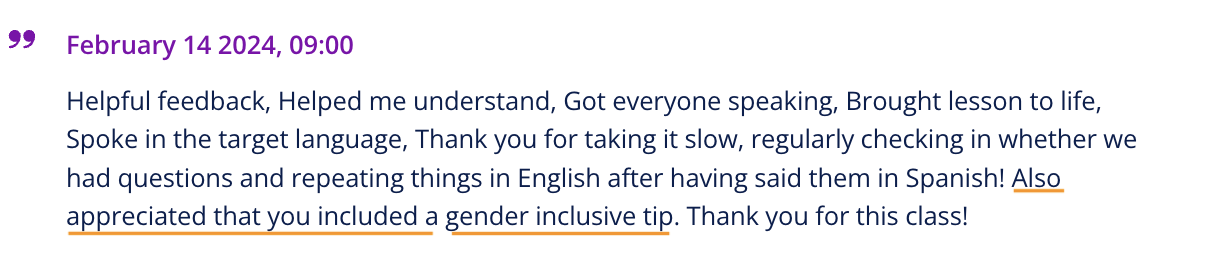
These strategies and attitudes in the classroom (asynchronous and synchronous) have received very positive feedback. For many people this can mean feeling included and supported. Here is an anonymous comment I received from a Lingoda Spanish lesson:
Wenn du den Blog-Artikel magst dann klicke auf das Herz. Das hilft uns zu verstehen, welche Artikel besonders lesenswert sind.