

eduki Qualität
74 Seiten
eduki Qualität
12 Seiten
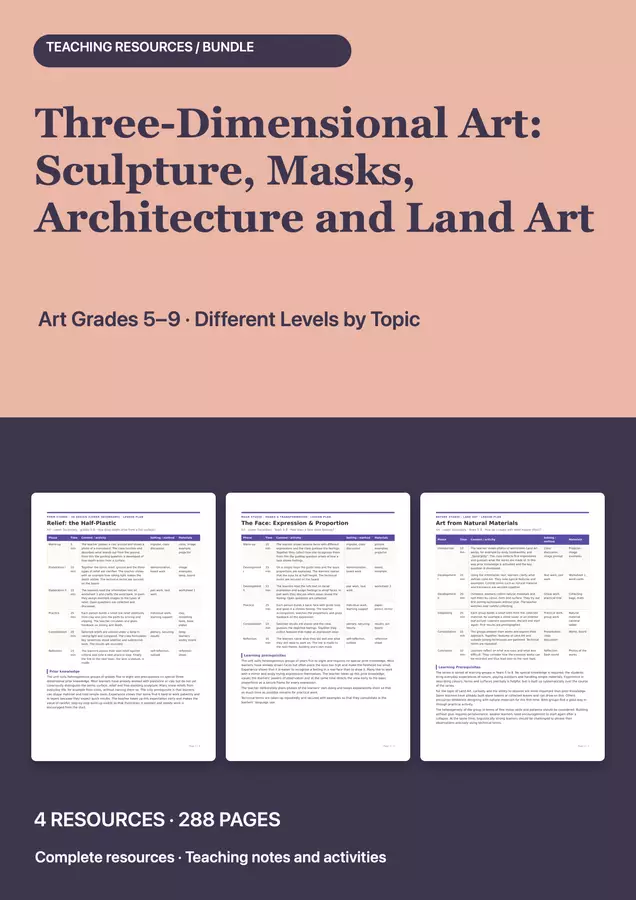


Three-Dimensional Art: Sculpture, Masks, Architecture and Land Art: this bundle contains 4 complete teaching resources with 288 PDF pages in total. Art Grades 5–9 · Different Levels by Topic. All included resources are the English-language editions. They can be taught separately or selected to build a connected sequence around the named topics.
Use the individual packs to introduce concepts, practise subject vocabulary, compare examples and support written or practical outcomes. Select tasks according to learners’ prior knowledge and the level stated in each resource; the bundle is a collection of the listed complete products, rather than a newly sequenced textbook or a promise that every task suits every grade.
Three English-language Art units for Grades 5–8 exploring three-dimensional design. Learners create reliefs, wire sculptures and free-standing papier-mache forms. Nine worksheets connect explanations of materials and techniques with practical making, observation and reflection. Teacher plans, expected outcomes and slides support the preparation and discussion of the projects.
Each topic contains three worksheets with explanatory texts, vocabulary and differentiated tasks. Knowledge questions establish the key terms; practical tasks ask learners to apply a technique, and analytical or reflective prompts connect choices with their visual effect. The answers describe expected outcomes for both written and practical work, so the discussion can focus on specific features of a design.
Mask Design and Construction: three connected English-language Art units for Grades 5–8. Nine worksheets connect explanations, subject vocabulary and practical tasks with observation, analysis and reflection. Each unit has its own teacher plan, detailed expected outcomes and classroom presentation, so teachers can select a topic or use the workshop sequence together.
Introduce a visual example or practical question, establish the key terms and let learners test a small idea before developing a more considered response. Ask pupils to explain how a choice affects the result. Short partner discussions and work reviews can connect making with analysis, while the expected outcomes provide concrete criteria for feedback on both written and practical work.
Land Art and Nature: three connected English-language Art units for Grades 5–8. Nine worksheets connect explanations, subject vocabulary and practical tasks with observation, analysis and reflection. Each unit has its own teacher plan, detailed expected outcomes and classroom presentation, so teachers can select a topic or use the workshop sequence together.
Introduce a visual example or practical question, establish the key terms and let learners test a small idea before developing a more considered response. Ask pupils to explain how a choice affects the result. Short partner discussions and work reviews can connect making with analysis, while the expected outcomes provide concrete criteria for feedback on both written and practical work.
Architecture: Space, Models and Design: three connected English-language Art units for Grades 7–9. Nine worksheets connect explanations, subject vocabulary and practical tasks with observation, analysis and reflection. Each unit has its own teacher plan, detailed expected outcomes and classroom presentation, so teachers can select a topic or use the workshop sequence together.
Introduce a visual example or practical question, establish the key terms and let learners test a small idea before developing a more considered response. Ask pupils to explain how a choice affects the result. Short partner discussions and work reviews can connect making with analysis, while the expected outcomes provide concrete criteria for feedback on both written and practical work.
You receive the complete files of the listed individual products, with the worksheets, answers, teaching notes and presentations described in each listing. File formats and additional preparation vary by resource: consult each included product for its exact inventory. PDF page totals count the complete printable editions, including covers, teaching notes and answers; editable versions are not counted again as extra pages.
Preparation requirements and any teacher-provided equipment or media are stated in the individual resources. Review those notes before choosing practical activities.
Does this add new worksheets to the individual packs? No. This offer groups the named complete products. If you already own one or more, check the overlap before purchasing. Text, tasks, answers and the supplied cover graphics were fully created with AI. Source references and resource-specific notes are retained in the individual files. The resources have not been classroom tested.
Sum of individual prices: 99.96 €. Bundle price: 69.99 € (saving: 30.0%).
Mask Design and Construction: three connected English-language Art units for Grades 5–8. Nine worksheets connect explanations, subject vocabulary and practical tasks with observation, analysis and reflection. Each unit has its own teacher plan, detailed expected outcomes and classroom presentation, so teachers can select a topic or use the workshop sequence together.What do the three units cover?The Face: Expression & ProportionThe proportions of the face: You can name the basic proportions of the face and build a balanced basic face using guide lines.Facial expression: feelings in the face: You can explain how eyebrows, eyes and mouth show feelings and give a drawing an expression.Drawing a face with expression: You can combine proportion and expression and draw a face with a clear, chosen feeling.Designing a maskFrom idea to mask: You can plan a mask idea, choose a fitting basic shape and mark the eye holes correctly.Building a mask: You can build a stable basic shape from simple materials and work it cleanly and safely.Designing the mask: You can give your mask a clear expression, recognisable even from afar, with colour, pattern and surface.Masks of the culturesMasks in festival and theatre: You can describe with examples how masks are used in festivals and in theatre and place them factually.Meaning and function of masks: You can name different functions of masks and explain that many masks have a deep meaning.Looking at masks respectfully: You can explain how one views masks of other cultures with care and lets them inspire you respectfully.What is included?Nine worksheets with explanatory texts, vocabulary and differentiated tasks.Three teacher lesson plans with prerequisites, competencies, suggested phases, methodology, differentiation and preparation notes.Three detailed answer and expected-outcome documents.Three classroom slide decks.One combined printable PDF and a separate archive containing editable text documents and presentations.Introduce a visual example or practical question, establish the key terms and let learners test a small idea before developing a more considered response. Ask pupils to explain how a choice affects the result. Short partner discussions and work reviews can connect making with analysis, while the expected outcomes provide concrete criteria for feedback on both written and practical work.Preparation for the practical workThe Face: Expression & Proportion: Needed are paper, pencils of different hardness, an eraser and, for the entry, several picture examples with different expressions. Small hand mirrors are helpful so that learners can try expressions themselves and observe them.Designing a mask: Needed are firm cardboard or coloured paper, newspaper and paste for papier-mâché, scissors, if applicable craft knives with bases, pencils for the drafts as well as colours, brushes and water containers. For the hold elastic bands or sticks are suitable.Masks of the cultures: Needed are carefully chosen picture examples of masks from different cultures and times, if possible with a short, factual note on origin and purpose. For the development the worksheets with short information texts are suitable.The school provides practical equipment and materials and selects the visual examples needed for analysis. A separate licensed collection of photographs or artwork reproductions is not included. Read the preparation and organisation notes before the activity, plan workspace and storage where needed, and adjust the amount of support to prior experience. Editable files allow prompts and examples to be adapted to the class.Frequently asked questionsWhich language is included? This is the English edition; German files are not included. Are answers provided? Detailed sample answers and expected outcomes accompany each unit. Can I edit the material? Worksheets, plans, answer guidance and slides are included in editable form in the separate archive. Can units be used individually? Each has a complete set of the teaching files described above.Source and tool notes from the supplied material are retained. Texts, tasks, answers and design were generated with AI, as declared in the listing. PDF versions of the slides are included in the combined page count; identical editable versions are not counted twice.Download size: 72 pages in the combined PDF. Slide pages are included in this count. The editable archive contains 15 text documents and 3 slide decks.
Klassenstufen: 5-6. Klasse
Land Art and Nature: three connected English-language Art units for Grades 5–8. Nine worksheets connect explanations, subject vocabulary and practical tasks with observation, analysis and reflection. Each unit has its own teacher plan, detailed expected outcomes and classroom presentation, so teachers can select a topic or use the workshop sequence together.What do the three units cover?Art from Natural MaterialsWhat is Land Art?: Students explain what Land Art is and name typical features of this art movement.Discovering nature's materials: Students collect natural materials carefully and sort them by colour, form and surface.Building without glue: Students try out joining techniques with which natural materials hold together without glue.Arranging: Line, Circle, PatternThe row and the line: Students lay natural materials into rows and lines and thereby create simple picture effects.The circle as a basic form: Students create circles and mandalas from natural materials and recognise their particular effect.Pattern and rhythm: Students create patterns through repetition and try out rhythm in their arrangements.Transience & DocumentationUnderstanding transience: Students explain why Land Art is transient and interpret transience as part of the art.Photographing Land Art: Students photograph Land Art works deliberately and pay attention to perspective, light and framing.Documenting and presenting: Students document their works with a title and text and prepare a small presentation.What is included?Nine worksheets with explanatory texts, vocabulary and differentiated tasks.Three teacher lesson plans with prerequisites, competencies, suggested phases, methodology, differentiation and preparation notes.Three detailed answer and expected-outcome documents.Three classroom slide decks.One combined printable PDF and a separate archive containing editable text documents and presentations.Introduce a visual example or practical question, establish the key terms and let learners test a small idea before developing a more considered response. Ask pupils to explain how a choice affects the result. Short partner discussions and work reviews can connect making with analysis, while the expected outcomes provide concrete criteria for feedback on both written and practical work.Preparation for the practical workArt from Natural Materials: What is needed above all are natural materials collected on site: stones, leaves, twigs, bark, grasses and the like. For the indoor part, collecting bags or baskets, mats to lay things out and the worksheets are suitable.Arranging: Line, Circle, Pattern: Natural materials in sufficient quantity and variety are needed so that rows, circles and patterns can be laid. A string for drawing circles, small sticks and level surfaces outdoors or large mats indoors are helpful.Transience & Documentation: What is needed are the works created in the previous topics or newly made, cameras or tablets for photographing as well as paper, pens and possibly a printer for the documentation. For a digital exhibition a projector or screen is suitable.The school provides practical equipment and materials and selects the visual examples needed for analysis. A separate licensed collection of photographs or artwork reproductions is not included. Read the preparation and organisation notes before the activity, plan workspace and storage where needed, and adjust the amount of support to prior experience. Editable files allow prompts and examples to be adapted to the class.Frequently asked questionsWhich language is included? This is the English edition; German files are not included. Are answers provided? Detailed sample answers and expected outcomes accompany each unit. Can I edit the material? Worksheets, plans, answer guidance and slides are included in editable form in the separate archive. Can units be used individually? Each has a complete set of the teaching files described above.Source and tool notes from the supplied material are retained. Texts, tasks, answers and design were generated with AI, as declared in the listing. PDF versions of the slides are included in the combined page count; identical editable versions are not counted twice.Download size: 72 pages in the combined PDF. Slide pages are included in this count. The editable archive contains 15 text documents and 3 slide decks.
Klassenstufen: 5-6. Klasse
Three English-language Art units for Grades 5–8 exploring three-dimensional design. Learners create reliefs, wire sculptures and free-standing papier-mache forms. Nine worksheets connect explanations of materials and techniques with practical making, observation and reflection. Teacher plans, expected outcomes and slides support the preparation and discussion of the projects.What do the three topics cover?Relief: distinguish types of relief and the relationship between a surface and a projecting form; build up material using the additive method; explore removing material and using light and shadow to reveal depth. Practical tasks include developing a leaf motif and considering how the form changes under raking light.Wire Sculpture: understand wire as a line in space; bend, wrap and join it to create contours; consider movement and balance in a figure. Learners connect line, posture and support and review a sculpture from different viewpoints.Papier-Mache: plan and build a stable core, apply overlapping paper layers with paste, then prepare and paint the surface. Tasks connect proportions and an all-round view with the construction and finish of a free-standing sculpture.Each topic contains three worksheets with explanatory texts, vocabulary and differentiated tasks. Knowledge questions establish the key terms; practical tasks ask learners to apply a technique, and analytical or reflective prompts connect choices with their visual effect. The answers describe expected outcomes for both written and practical work, so the discussion can focus on specific features of a design.What is included?Nine worksheets: three for relief, three for wire sculpture and three for papier-mache.Three lesson plans with objectives, suggested phases, differentiation and preparation notes.Three detailed answer and expected-outcome documents.Three classroom slide decks.One combined printable PDF and a separate archive containing editable text documents and presentations.Begin with a physical object or image example, establish the relevant technique and let learners test a small form before developing their own design. Short pauses for looking from another angle or changing the light help pupils connect making with observation. Use the expected outcomes to discuss what holds together, what appears balanced and which surface or contour choices make the intended form clear.Practical materials are provided by the school. Depending on the selected project, the plans call for clay or modelling compound and tools; suitable craft wire, pliers, cutters and bases; or newspaper, tape, a core, paste and paints. Prepare appropriate image examples, protect work surfaces and plan storage and drying time. Choose tools and working methods for the age and experience of the group and follow the organisation notes in the teacher plans. The download supplies teaching files rather than equipment or finished objects.Frequently asked questionsWhich language is included? This is the English edition. German files are not included. Are solutions provided? Yes. Detailed answers and expected outcomes accompany each topic, including guidance for practical tasks. Can I edit the resources? Editable worksheets, teacher plans, answer files and presentations are included in the separate archive. Can the topics be used separately? Each has its own plan, worksheets, guidance and slides.Source and tool notes are retained from the supplied material. Texts, tasks, guidance and visuals were generated with AI, as declared in the listing. PDF versions of the slides are included in the combined page count; identical editable versions are not counted twice.Download size: 72 pages in the combined PDF. Slide pages are included in this count. The editable archive contains 15 text documents and 3 slide decks.
Klassenstufen: 5-6. Klasse
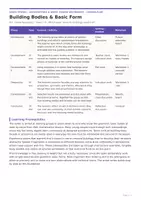
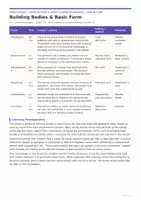
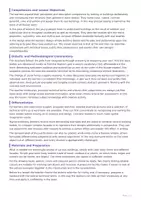
Architecture: Space, Models and Design: three connected English-language Art units for Grades 7–9. Nine worksheets connect explanations, subject vocabulary and practical tasks with observation, analysis and reflection. Each unit has its own teacher plan, detailed expected outcomes and classroom presentation, so teachers can select a topic or use the workshop sequence together.What do the three units cover?Building Bodies & Basic FormBasic Forms of Architecture: Students name the geometric basic bodies and recognise them again in simple buildings.Combining Building Bodies: Students investigate how buildings arise through the adding and removing of building bodies.Facade, Proportion and Order: Students describe facades and investigate proportion, symmetry and the rhythm of the openings.From Plan to ModelPlan and Elevation: Students read simple floor plans and elevations and assign them to a building.Scale: Students explain scale and convert simple measurements between reality and model.Building a Model: Students plan and build a simple architectural model from cardboard and describe their working steps.City & Public SpacePublic Space: Students describe features of public spaces and judge their quality of stay.Reading the City: Students distinguish buildings by their function and assign them to areas of the city.A Liveable City: Students develop ideas for a liveable, sustainable city and justify their design decisions.What is included?Nine worksheets with explanatory texts, vocabulary and differentiated tasks.Three teacher lesson plans with prerequisites, competencies, suggested phases, methodology, differentiation and preparation notes.Three detailed answer and expected-outcome documents.Three classroom slide decks.One combined printable PDF and a separate archive containing editable text documents and presentations.Introduce a visual example or practical question, establish the key terms and let learners test a small idea before developing a more considered response. Ask pupils to explain how a choice affects the result. Short partner discussions and work reviews can connect making with analysis, while the expected outcomes provide concrete criteria for feedback on both written and practical work.Preparation for the practical workBuilding Bodies & Basic Form: What is needed are meaningful photos of various buildings, ideally with clear basic forms and different facades. Simple geometric body models made of wood, cardboard or plastic, on which faces, edges and corners can be shown, are helpful.From Plan to Model: What is needed are grey board or firm drawing card, cutting mats, rulers of metal or with a metal edge, craft knives or scissors as well as a suitable adhesive. For each learning group a prepared example model and matching plans should be ready so that the introduction succeeds vividly.City & Public Space: What is needed are meaningful photos of public spaces, ideally with different quality of stay, as well as pictures of various building types with recognisable functions. A simple city plan or map excerpt can illustrate the assignment of functions.The school provides practical equipment and materials and selects the visual examples needed for analysis. A separate licensed collection of photographs or artwork reproductions is not included. Read the preparation and organisation notes before the activity, plan workspace and storage where needed, and adjust the amount of support to prior experience. Editable files allow prompts and examples to be adapted to the class.Frequently asked questionsWhich language is included? This is the English edition; German files are not included. Are answers provided? Detailed sample answers and expected outcomes accompany each unit. Can I edit the material? Worksheets, plans, answer guidance and slides are included in editable form in the separate archive. Can units be used individually? Each has a complete set of the teaching files described above.Source and tool notes from the supplied material are retained. Texts, tasks, answers and design were generated with AI, as declared in the listing. PDF versions of the slides are included in the combined page count; identical editable versions are not counted twice.Download size: 72 pages in the combined PDF. Slide pages are included in this count. The editable archive contains 15 text documents and 3 slide decks.
Klassenstufen: 7-8. Klasse



Bewertungen und Kommentare