

eduki Qualität
74 Seiten
eduki Qualität
12 Seiten
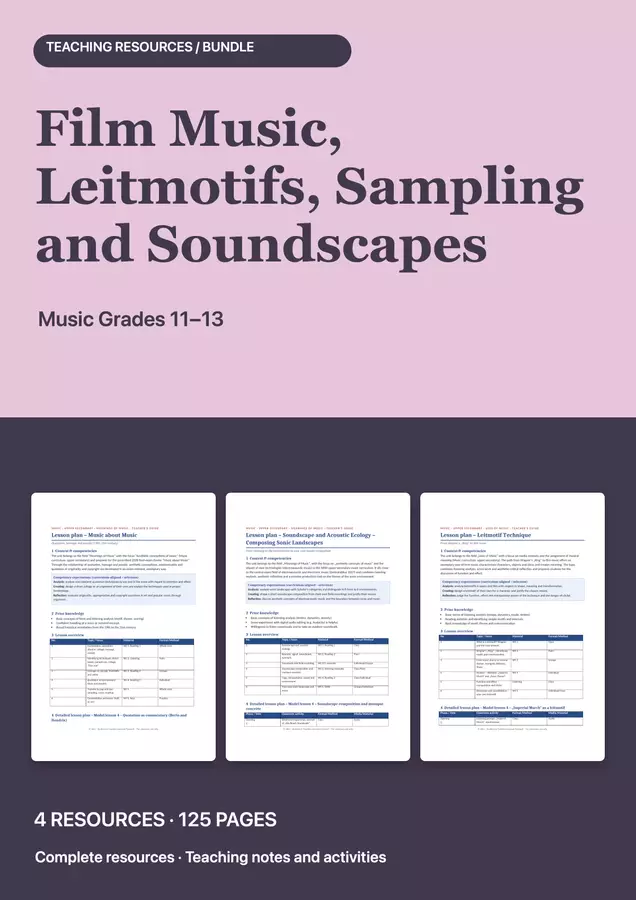


Film Music, Leitmotifs, Sampling and Soundscapes: this bundle contains 4 complete teaching resources with 125 PDF pages in total. Music Grades 11–13. All included resources are the English-language editions. They can be taught separately or selected to build a connected sequence around the named topics.
Use the individual packs to introduce concepts, practise subject vocabulary, compare examples and support written or practical outcomes. Select tasks according to learners’ prior knowledge and the level stated in each resource; the bundle is a collection of the listed complete products, rather than a newly sequenced textbook or a promise that every task suits every grade.
Music about Music: Quotation, Homage, Parody and Sampling: an English-language teaching unit for upper secondary Music, Grades 11–13. Five worksheets, three background readings and separate answer keys connect musical concepts with analysis, interpretation and a practical or written response. A teacher lesson plan and classroom presentation support the sequence.
Use the reading texts to introduce the vocabulary and context, then connect the terms with a selected musical example. Ask learners to support an observation with a passage, describe the technique and explain its effect. Comparing interpretations helps distinguish what can be heard or read in the example from a broader judgement. The answer keys support review of both technical knowledge and the quality of a reasoned response.
Soundscapes and Acoustic Ecology: an English-language teaching unit for upper secondary Music, Grades 11–13. Five worksheets, three background readings and separate answer keys connect musical concepts with analysis, interpretation and a practical or written response. A teacher lesson plan and classroom presentation support the sequence.
Use the reading texts to introduce the vocabulary and context, then connect the terms with a selected musical example. Ask learners to support an observation with a passage, describe the technique and explain its effect. Comparing interpretations helps distinguish what can be heard or read in the example from a broader judgement. The answer keys support review of both technical knowledge and the quality of a reasoned response.
Leitmotifs: From Wagner to Film: an English-language teaching unit for upper secondary Music, Grades 11–13. Five worksheets, three background readings and separate answer keys connect musical concepts with analysis, interpretation and a practical or written response. A teacher lesson plan and classroom presentation support the sequence.
Use the reading texts to introduce the vocabulary and context, then connect the terms with a selected musical example. Ask learners to support an observation with a passage, describe the technique and explain its effect. Comparing interpretations helps distinguish what can be heard or read in the example from a broader judgement. The answer keys support review of both technical knowledge and the quality of a reasoned response.
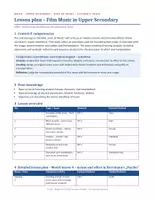
Film Music: Analysis, Functions and Design: an English-language teaching unit for upper secondary Music, Grades 11–13. Five worksheets, three background readings and separate answer keys connect musical concepts with analysis, interpretation and a practical or written response. A teacher lesson plan and classroom presentation support the sequence.
Use the reading texts to introduce the vocabulary and context, then connect the terms with a selected musical example. Ask learners to support an observation with a passage, describe the technique and explain its effect. Comparing interpretations helps distinguish what can be heard or read in the example from a broader judgement. The answer keys support review of both technical knowledge and the quality of a reasoned response.
You receive the complete files of the listed individual products, with the worksheets, answers, teaching notes and presentations described in each listing. File formats and additional preparation vary by resource: consult each included product for its exact inventory. PDF page totals count the complete printable editions, including covers, teaching notes and answers; editable versions are not counted again as extra pages.
Teachers provide the selected audio or film examples and any required scores. Audio files, film clips and a licensed score collection are not included.
Does this add new worksheets to the individual packs? No. This offer groups the named complete products. If you already own one or more, check the overlap before purchasing. Text, tasks, answers and the supplied cover graphics were fully created with AI. Source references and resource-specific notes are retained in the individual files. The resources have not been classroom tested.
Sum of individual prices: 89.96 €. Bundle price: 69.99 € (saving: 22.2%).
Soundscapes and Acoustic Ecology: an English-language teaching unit for upper secondary Music, Grades 11–13. Five worksheets, three background readings and separate answer keys connect musical concepts with analysis, interpretation and a practical or written response. A teacher lesson plan and classroom presentation support the sequence.What do the five worksheets cover?Foundations – Soundscape and Acoustic EcologyI can explain the term soundscape. I can place acoustic ecology in context. I can describe my own sonic environment.Listening Analysis – Keynote, Signal, SoundmarkI can distinguish keynote, signal and soundmark. I can recognise hi-fi and lo-fi environments. I can evaluate a soundwalk.From Recording to Composition – Field RecordingI can plan and make a field recording. I can describe soundscape composition. I can relate it to musique concrète.Listening as an Attitude – Cage, Schizophonia and EnvironmentI can explain Cage's „4′33″“ as a listening concept. I can apply the term schizophonia. I can link sound to environmental questions.Practice and Essay – Your Own Sonic LandscapeI can plan my own sonic landscape. I can justify my design decisions. I can discuss the question „Is every noise music?“.What is included in the download?Five student worksheets with learning objectives, explanatory material and tasks.Five separate answer keys with expected responses and assessment guidance.Three background reading texts: The World as a Sonic Landscape; Keynote, Signal and Soundmark; From Listening to Composing.A teacher lesson plan with context, prerequisites, an overview, a detailed model lesson and suggestions for differentiation and assessment.A classroom slide deck.One combined printable PDF and a separate archive containing editable text documents and the presentation.Use the reading texts to introduce the vocabulary and context, then connect the terms with a selected musical example. Ask learners to support an observation with a passage, describe the technique and explain its effect. Comparing interpretations helps distinguish what can be heard or read in the example from a broader judgement. The answer keys support review of both technical knowledge and the quality of a reasoned response.Listening and score preparation: audio recordings, film clips and a separate collection of licensed score excerpts are not included. The teacher plan suggests examples for classroom use; provide suitable recordings and any score passages needed for the chosen tasks. The download supplies the teaching texts, task sheets, answer guidance and slides. Prepare the playback or projection setup and select excerpts of a manageable length for close listening.For differentiation, introduce terms together and use focused listening questions or marked score passages supplied by the teacher. More confident learners can compare examples or develop a practical or written transfer response. Select activities according to prior listening, notation and historical knowledge, and allow preparation time before discussion. The editable documents let you adjust the example, task wording and amount of support.Frequently asked questionsWhich language is supplied? This is the English edition; German files are not included. Are answers included? Each worksheet has its own answer key. Are audio files or complete scores included? No. The teacher supplies the listening examples and score passages used in class. Can I edit it? The separate archive contains editable worksheets, answer keys, readings, lesson plan and slide deck.Source and tool notes from the supplied files are retained. Texts, tasks, answers and design were generated with AI, as declared in the listing. PDF versions of the slides are included in the combined page count; identical editable versions are not counted twice.Download size: 33 pages in the combined PDF, including one credits and AI-disclosure page. Slide pages are included in this count. The editable archive contains 15 text documents, including an editable credits note, and 1 slide deck.
Klassenstufen: EF (10./11. Jhg.), Q1 (11./12. Jhg.)
Music about Music: Quotation, Homage, Parody and Sampling: an English-language teaching unit for upper secondary Music, Grades 11–13. Five worksheets, three background readings and separate answer keys connect musical concepts with analysis, interpretation and a practical or written response. A teacher lesson plan and classroom presentation support the sequence.What do the five worksheets cover?Foundations – Quotation, Allusion, Collage, Homage, ParodyI can define the key terms (quotation, allusion, collage, homage, parody). I can match examples to the appropriate term. I can explain intertextuality as an overarching principle.Identifying Quotation Techniques – Direct Quote, Paraphrase, CollageI can distinguish direct quote, paraphrase and collage. I can recognise the “Dies irae” as a wandering motif. I can support quotation techniques with a musical example.Homage vs. Parody – Intention and EffectI can distinguish homage and parody by intention and effect. I can interpret Stravinsky’s Pulcinella as a neoclassical appropriation. I can separate modern parody from the Baroque parody technique.Quotation as Commentary – Music, Politics and MemoryI can interpret quotations as carriers of meaning and commentary. I can explain Hendrix’s anthem arrangement in its historical context. I can read Berio’s collage as a reflection on music history.Transfer to Pop and Law – Sampling, Cover, Mashup and the EssayI can distinguish sampling, interpolation, cover and mashup. I can explain copyright conflicts using the sampling dispute. I can evaluate the question of originality in a structured essay.What is included in the download?Five student worksheets with learning objectives, explanatory material and tasks.Five separate answer keys with expected responses and assessment guidance.Three background reading texts: Music about Music; Between Homage and Parody; Quotation as Commentary — and the Question of Ownership.A teacher lesson plan with context, prerequisites, an overview, a detailed model lesson and suggestions for differentiation and assessment.A classroom slide deck.One combined printable PDF and a separate archive containing editable text documents and the presentation.Use the reading texts to introduce the vocabulary and context, then connect the terms with a selected musical example. Ask learners to support an observation with a passage, describe the technique and explain its effect. Comparing interpretations helps distinguish what can be heard or read in the example from a broader judgement. The answer keys support review of both technical knowledge and the quality of a reasoned response.Listening and score preparation: audio recordings, film clips and a separate collection of licensed score excerpts are not included. The teacher plan suggests examples for classroom use; provide suitable recordings and any score passages needed for the chosen tasks. The download supplies the teaching texts, task sheets, answer guidance and slides. Prepare the playback or projection setup and select excerpts of a manageable length for close listening.For differentiation, introduce terms together and use focused listening questions or marked score passages supplied by the teacher. More confident learners can compare examples or develop a practical or written transfer response. Select activities according to prior listening, notation and historical knowledge, and allow preparation time before discussion. The editable documents let you adjust the example, task wording and amount of support.Frequently asked questionsWhich language is supplied? This is the English edition; German files are not included. Are answers included? Each worksheet has its own answer key. Are audio files or complete scores included? No. The teacher supplies the listening examples and score passages used in class. Can I edit it? The separate archive contains editable worksheets, answer keys, readings, lesson plan and slide deck.Source and tool notes from the supplied files are retained. Texts, tasks, answers and design were generated with AI, as declared in the listing. PDF versions of the slides are included in the combined page count; identical editable versions are not counted twice.Download size: 31 pages in the combined PDF, including one credits and AI-disclosure page. Slide pages are included in this count. The editable archive contains 15 text documents, including an editable credits note, and 1 slide deck.
Klassenstufen: EF (10./11. Jhg.), Q1 (11./12. Jhg.)
Leitmotifs: From Wagner to Film: an English-language teaching unit for upper secondary Music, Grades 11–13. Five worksheets, three background readings and separate answer keys connect musical concepts with analysis, interpretation and a practical or written response. A teacher lesson plan and classroom presentation support the sequence.What do the five worksheets cover?Basics – What is a leitmotif?I can define the term leitmotif and give examples. I can explain Wagner’s idea of the total artwork. I can distinguish a motif from a theme.Wagner’s „Ring“ – identifying motifs and transformationI can name central motifs from the „Ring“. I can describe forms of motif transformation. I can interpret musical remembering and foreshadowing.From music drama to cinemaI can trace the path of the technique from Wagner to Hollywood. I can assign central film composers and their works. I can name similarities and differences to opera.Analysis – Williams’ „Imperial March“ and „Force Theme“I can describe the musical means of both motifs. I can bind the assignment of meaning to concrete means. I can interpret the recurrence and transformation of the motifs.Transfer – meaning or cliché?I can name the functions and effect of leitmotif technique. I can critically judge the danger of cliché. I can design a leitmotif of my own with justification.What is included in the download?Five student worksheets with learning objectives, explanatory material and tasks.Five separate answer keys with expected responses and assessment guidance.Three background reading texts: The Leitmotif; Wagner and the „Ring“; From the „Ring“ to Film Music.A teacher lesson plan with context, prerequisites, an overview, a detailed model lesson and suggestions for differentiation and assessment.A classroom slide deck.One combined printable PDF and a separate archive containing editable text documents and the presentation.Use the reading texts to introduce the vocabulary and context, then connect the terms with a selected musical example. Ask learners to support an observation with a passage, describe the technique and explain its effect. Comparing interpretations helps distinguish what can be heard or read in the example from a broader judgement. The answer keys support review of both technical knowledge and the quality of a reasoned response.Listening and score preparation: audio recordings, film clips and a separate collection of licensed score excerpts are not included. The teacher plan suggests examples for classroom use; provide suitable recordings and any score passages needed for the chosen tasks. The download supplies the teaching texts, task sheets, answer guidance and slides. Prepare the playback or projection setup and select excerpts of a manageable length for close listening.For differentiation, introduce terms together and use focused listening questions or marked score passages supplied by the teacher. More confident learners can compare examples or develop a practical or written transfer response. Select activities according to prior listening, notation and historical knowledge, and allow preparation time before discussion. The editable documents let you adjust the example, task wording and amount of support.Frequently asked questionsWhich language is supplied? This is the English edition; German files are not included. Are answers included? Each worksheet has its own answer key. Are audio files or complete scores included? No. The teacher supplies the listening examples and score passages used in class. Can I edit it? The separate archive contains editable worksheets, answer keys, readings, lesson plan and slide deck.Source and tool notes from the supplied files are retained. Texts, tasks, answers and design were generated with AI, as declared in the listing. PDF versions of the slides are included in the combined page count; identical editable versions are not counted twice.Download size: 30 pages in the combined PDF, including one credits and AI-disclosure page. Slide pages are included in this count. The editable archive contains 15 text documents, including an editable credits note, and 1 slide deck.
Klassenstufen: EF (10./11. Jhg.), Q1 (11./12. Jhg.)
Film Music: Analysis, Functions and Design: an English-language teaching unit for upper secondary Music, Grades 11–13. Five worksheets, three background readings and separate answer keys connect musical concepts with analysis, interpretation and a practical or written response. A teacher lesson plan and classroom presentation support the sequence.What do the five worksheets cover?Basics – functions of film musicI can distinguish paraphrasing, polarising and counterpointing. I can separate diegetic from non-diegetic music. I can explain the basic function of film music as steering effect.Effect analysis – music changes the sceneI can describe how music changes the reading of a scene. I can identify and name mickey-mousing, stinger and underscoring. I can explain the effect of music on emotion and the sense of time.History and styles – Steiner, Herrmann, ZimmerI can outline the development of film music in its main stages. I can place Steiner, Herrmann and Zimmer stylistically. I can explain the leitmotif idea and assign examples.Analysis – means and effect in detailI can name the musical means of a scene precisely. I can relate means systematically to their effect. I can formulate a reasoned analytical judgement.Transfer – does film music manipulate?I can weigh arguments for and against a manipulation thesis. I can design and justify an original scene score. I can write a structured discursive essay.What is included in the download?Five student worksheets with learning objectives, explanatory material and tasks.Five separate answer keys with expected responses and assessment guidance.Three background reading texts: The Functions of Film Music; Effect and Technique; History and Styles of Film Music.A teacher lesson plan with context, prerequisites, an overview, a detailed model lesson and suggestions for differentiation and assessment.A classroom slide deck.One combined printable PDF and a separate archive containing editable text documents and the presentation.Use the reading texts to introduce the vocabulary and context, then connect the terms with a selected musical example. Ask learners to support an observation with a passage, describe the technique and explain its effect. Comparing interpretations helps distinguish what can be heard or read in the example from a broader judgement. The answer keys support review of both technical knowledge and the quality of a reasoned response.Listening and score preparation: audio recordings, film clips and a separate collection of licensed score excerpts are not included. The teacher plan suggests examples for classroom use; provide suitable recordings and any score passages needed for the chosen tasks. The download supplies the teaching texts, task sheets, answer guidance and slides. Prepare the playback or projection setup and select excerpts of a manageable length for close listening.For differentiation, introduce terms together and use focused listening questions or marked score passages supplied by the teacher. More confident learners can compare examples or develop a practical or written transfer response. Select activities according to prior listening, notation and historical knowledge, and allow preparation time before discussion. The editable documents let you adjust the example, task wording and amount of support.Frequently asked questionsWhich language is supplied? This is the English edition; German files are not included. Are answers included? Each worksheet has its own answer key. Are audio files or complete scores included? No. The teacher supplies the listening examples and score passages used in class. Can I edit it? The separate archive contains editable worksheets, answer keys, readings, lesson plan and slide deck.Source and tool notes from the supplied files are retained. Texts, tasks, answers and design were generated with AI, as declared in the listing. PDF versions of the slides are included in the combined page count; identical editable versions are not counted twice.Download size: 31 pages in the combined PDF, including one credits and AI-disclosure page. Slide pages are included in this count. The editable archive contains 15 text documents, including an editable credits note, and 1 slide deck.
Klassenstufen: EF (10./11. Jhg.), Q1 (11./12. Jhg.)



Bewertungen und Kommentare