

eduki Qualität
74 Seiten
eduki Qualität
12 Seiten
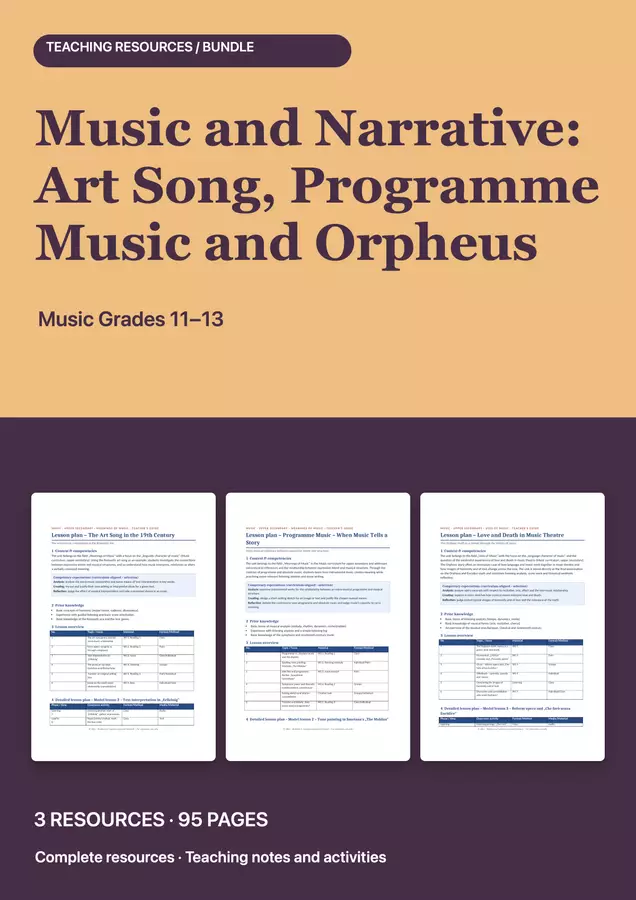



Music and Narrative: Art Song, Programme Music and Orpheus: this bundle contains 3 complete teaching resources with 95 PDF pages in total. Music Grades 11–13. All included resources are the English-language editions. They can be taught separately or selected to build a connected sequence around the named topics.
Use the individual packs to introduce concepts, practise subject vocabulary, compare examples and support written or practical outcomes. Select tasks according to learners’ prior knowledge and the level stated in each resource; the bundle is a collection of the listed complete products, rather than a newly sequenced textbook or a promise that every task suits every grade.
The Art Song in the Nineteenth Century: an English-language teaching unit for upper secondary Music, Grades 11–13. Five worksheets, three background readings and separate answer keys connect musical concepts with analysis, interpretation and a practical or written response. A teacher lesson plan and classroom presentation support the sequence.
Use the reading texts to introduce the vocabulary and context, then connect the terms with a selected musical example. Ask learners to support an observation with a passage, describe the technique and explain its effect. Comparing interpretations helps distinguish what can be heard or read in the example from a broader judgement. The answer keys support review of both technical knowledge and the quality of a reasoned response.
Programme Music: When Music Tells a Story: an English-language teaching unit for upper secondary Music, Grades 11–13. Five worksheets, three background readings and separate answer keys connect musical concepts with analysis, interpretation and a practical or written response. A teacher lesson plan and classroom presentation support the sequence.
Use the reading texts to introduce the vocabulary and context, then connect the terms with a selected musical example. Ask learners to support an observation with a passage, describe the technique and explain its effect. Comparing interpretations helps distinguish what can be heard or read in the example from a broader judgement. The answer keys support review of both technical knowledge and the quality of a reasoned response.
The Orpheus Myth: Love and Death in Music: an English-language teaching unit for upper secondary Music, Grades 11–13. Five worksheets, three background readings and separate answer keys connect musical concepts with analysis, interpretation and a practical or written response. A teacher lesson plan and classroom presentation support the sequence.
Use the reading texts to introduce the vocabulary and context, then connect the terms with a selected musical example. Ask learners to support an observation with a passage, describe the technique and explain its effect. Comparing interpretations helps distinguish what can be heard or read in the example from a broader judgement. The answer keys support review of both technical knowledge and the quality of a reasoned response.
You receive the complete files of the listed individual products, with the worksheets, answers, teaching notes and presentations described in each listing. File formats and additional preparation vary by resource: consult each included product for its exact inventory. PDF page totals count the complete printable editions, including covers, teaching notes and answers; editable versions are not counted again as extra pages.
Teachers provide the selected audio or film examples and any required scores. Audio files, film clips and a licensed score collection are not included.
Does this add new worksheets to the individual packs? No. This offer groups the named complete products. If you already own one or more, check the overlap before purchasing. Text, tasks, answers and the supplied cover graphics were fully created with AI. Source references and resource-specific notes are retained in the individual files. The resources have not been classroom tested.
Sum of individual prices: 64.97 €. Bundle price: 49.99 € (saving: 23.1%).
The Orpheus Myth: Love and Death in Music: an English-language teaching unit for upper secondary Music, Grades 11–13. Five worksheets, three background readings and separate answer keys connect musical concepts with analysis, interpretation and a practical or written response. A teacher lesson plan and classroom presentation support the sequence.What do the five worksheets cover?Basics – Myth, opera and existential themesI can retell the myth of Orpheus and Eurydice in outline. I can name opera as a genre and its building blocks. I can explain love and death as existential experiences in music theatre.Monteverdi „L’Orfeo“ – early Baroque and monodyI can place „L’Orfeo“ (1607) historically as an early Baroque opera. I can explain monody, recitative and the seconda pratica. I can support the effect of „Possente spirto“ through the text-music relationship.Gluck – reform opera and „Che farò“I can explain Gluck’s reform ideals (simplicity, truth, drama). I can distinguish „Orfeo ed Euridice“ (1762) from Baroque opera. I can analyse the effect of „Che farò senza Euridice“.Offenbach – operetta, parody and social critiqueI can characterise operetta as a genre and as a form of parody. I can place Offenbach’s „Orphée aux enfers“ (1858) in its social context. I can interpret the cancan as a means of satire.Transfer – Why does every era set Orpheus anew?I can compare the images of humanity and of love across the three periods. I can explain the link between worldview and musical setting. I can write a reasoned discursive essay on the Orpheus story.What is included in the download?Five student worksheets with learning objectives, explanatory material and tasks.Five separate answer keys with expected responses and assessment guidance.Three background reading texts: Orpheus – Myth and the Birth of Opera; Recitative, Aria and Reform Opera; One Myth, Three Eras.A teacher lesson plan with context, prerequisites, an overview, a detailed model lesson and suggestions for differentiation and assessment.A classroom slide deck.One combined printable PDF and a separate archive containing editable text documents and the presentation.Use the reading texts to introduce the vocabulary and context, then connect the terms with a selected musical example. Ask learners to support an observation with a passage, describe the technique and explain its effect. Comparing interpretations helps distinguish what can be heard or read in the example from a broader judgement. The answer keys support review of both technical knowledge and the quality of a reasoned response.Listening and score preparation: audio recordings, film clips and a separate collection of licensed score excerpts are not included. The teacher plan suggests examples for classroom use; provide suitable recordings and any score passages needed for the chosen tasks. The download supplies the teaching texts, task sheets, answer guidance and slides. Prepare the playback or projection setup and select excerpts of a manageable length for close listening.For differentiation, introduce terms together and use focused listening questions or marked score passages supplied by the teacher. More confident learners can compare examples or develop a practical or written transfer response. Select activities according to prior listening, notation and historical knowledge, and allow preparation time before discussion. The editable documents let you adjust the example, task wording and amount of support.Frequently asked questionsWhich language is supplied? This is the English edition; German files are not included. Are answers included? Each worksheet has its own answer key. Are audio files or complete scores included? No. The teacher supplies the listening examples and score passages used in class. Can I edit it? The separate archive contains editable worksheets, answer keys, readings, lesson plan and slide deck.Source and tool notes from the supplied files are retained. Texts, tasks, answers and design were generated with AI, as declared in the listing. PDF versions of the slides are included in the combined page count; identical editable versions are not counted twice.Download size: 32 pages in the combined PDF, including one credits and AI-disclosure page. Slide pages are included in this count. The editable archive contains 15 text documents, including an editable credits note, and 1 slide deck.
Klassenstufen: EF (10./11. Jhg.), Q1 (11./12. Jhg.)
The Art Song in the Nineteenth Century: an English-language teaching unit for upper secondary Music, Grades 11–13. Five worksheets, three background readings and separate answer keys connect musical concepts with analysis, interpretation and a practical or written response. A teacher lesson plan and classroom presentation support the sequence.What do the five worksheets cover?Basics – the art song genre and the word-music relationshipI can explain the art song genre and its three levels. I can describe the piano as an equal partner. I can apply the term word-music relationship.Form types – strophic and through-composed songI can distinguish the three form types of the art song. I can explain each type's strengths for text interpretation. I can place the term song cycle.Analysing text interpretation – Schubert's „Erlkönig"I can name the four roles and their musical characterisation. I can interpret the piano figuration as an image. I can describe the dramatic build-up across the song.The piano as narrator – „Gretchen am Spinnrade" and Schumann's „Dichterliebe"I can interpret the spinning-wheel figure and its dramatic climax. I can describe the open harmony in Schumann's song. I can explain the function of piano postludes.Transfer and essay – does music reinforce or alter a poem?I can bring the means of text interpretation together systematically. I can justify an original setting idea. I can write a balanced essay on the word-music relationship.What is included in the download?Five student worksheets with learning objectives, explanatory material and tasks.Five separate answer keys with expected responses and assessment guidance.Three background reading texts: The Romantic Art Song; Strophic and Through-Composed Song; Means of Text Interpretation.A teacher lesson plan with context, prerequisites, an overview, a detailed model lesson and suggestions for differentiation and assessment.A classroom slide deck.One combined printable PDF and a separate archive containing editable text documents and the presentation.Use the reading texts to introduce the vocabulary and context, then connect the terms with a selected musical example. Ask learners to support an observation with a passage, describe the technique and explain its effect. Comparing interpretations helps distinguish what can be heard or read in the example from a broader judgement. The answer keys support review of both technical knowledge and the quality of a reasoned response.Listening and score preparation: audio recordings, film clips and a separate collection of licensed score excerpts are not included. The teacher plan suggests examples for classroom use; provide suitable recordings and any score passages needed for the chosen tasks. The download supplies the teaching texts, task sheets, answer guidance and slides. Prepare the playback or projection setup and select excerpts of a manageable length for close listening.For differentiation, introduce terms together and use focused listening questions or marked score passages supplied by the teacher. More confident learners can compare examples or develop a practical or written transfer response. Select activities according to prior listening, notation and historical knowledge, and allow preparation time before discussion. The editable documents let you adjust the example, task wording and amount of support.Frequently asked questionsWhich language is supplied? This is the English edition; German files are not included. Are answers included? Each worksheet has its own answer key. Are audio files or complete scores included? No. The teacher supplies the listening examples and score passages used in class. Can I edit it? The separate archive contains editable worksheets, answer keys, readings, lesson plan and slide deck.Source and tool notes from the supplied files are retained. Texts, tasks, answers and design were generated with AI, as declared in the listing. PDF versions of the slides are included in the combined page count; identical editable versions are not counted twice.Download size: 32 pages in the combined PDF, including one credits and AI-disclosure page. Slide pages are included in this count. The editable archive contains 15 text documents, including an editable credits note, and 1 slide deck.
Klassenstufen: EF (10./11. Jhg.), Q1 (11./12. Jhg.)
Programme Music: When Music Tells a Story: an English-language teaching unit for upper secondary Music, Grades 11–13. Five worksheets, three background readings and separate answer keys connect musical concepts with analysis, interpretation and a practical or written response. A teacher lesson plan and classroom presentation support the sequence.What do the five worksheets cover?Basics – Programme Music and Absolute MusicI can distinguish programme music from absolute music. I can assign the types of programme (narrative, pictorial, characterising). I can restate the positions of Hanslick and Liszt in my own words.Spotting Tone Painting – Smetana's „The Moldau“I can name tone painting (hypotyposis) at concrete points. I can describe the musical means of a scene. I can support the link between sound and programme.idée fixe and Programme – Berlioz's „Symphonie fantastique“I can explain the idée fixe as a basic technique. I can describe its transformation across movements. I can connect the programme with the musical shape.Symphonic Poem and Thematic Transformation – Liszt and R. StraussI can describe the symphonic poem as a genre. I can demonstrate thematic transformation in an example. I can recognise leitmotifs in Strauss's tone poems.Transfer and Debate – Does Music Need a Programme?I can contrast the arguments of both camps. I can deploy examples deliberately as evidence. I can formulate a reasoned aesthetic judgement.What is included in the download?Five student worksheets with learning objectives, explanatory material and tasks.Five separate answer keys with expected responses and assessment guidance.Three background reading texts: When Music Tells a Story; How Music Builds Meaning; From Berlioz to Strauss.A teacher lesson plan with context, prerequisites, an overview, a detailed model lesson and suggestions for differentiation and assessment.A classroom slide deck.One combined printable PDF and a separate archive containing editable text documents and the presentation.Use the reading texts to introduce the vocabulary and context, then connect the terms with a selected musical example. Ask learners to support an observation with a passage, describe the technique and explain its effect. Comparing interpretations helps distinguish what can be heard or read in the example from a broader judgement. The answer keys support review of both technical knowledge and the quality of a reasoned response.Listening and score preparation: audio recordings, film clips and a separate collection of licensed score excerpts are not included. The teacher plan suggests examples for classroom use; provide suitable recordings and any score passages needed for the chosen tasks. The download supplies the teaching texts, task sheets, answer guidance and slides. Prepare the playback or projection setup and select excerpts of a manageable length for close listening.For differentiation, introduce terms together and use focused listening questions or marked score passages supplied by the teacher. More confident learners can compare examples or develop a practical or written transfer response. Select activities according to prior listening, notation and historical knowledge, and allow preparation time before discussion. The editable documents let you adjust the example, task wording and amount of support.Frequently asked questionsWhich language is supplied? This is the English edition; German files are not included. Are answers included? Each worksheet has its own answer key. Are audio files or complete scores included? No. The teacher supplies the listening examples and score passages used in class. Can I edit it? The separate archive contains editable worksheets, answer keys, readings, lesson plan and slide deck.Source and tool notes from the supplied files are retained. Texts, tasks, answers and design were generated with AI, as declared in the listing. PDF versions of the slides are included in the combined page count; identical editable versions are not counted twice.Download size: 31 pages in the combined PDF, including one credits and AI-disclosure page. Slide pages are included in this count. The editable archive contains 15 text documents, including an editable credits note, and 1 slide deck.
Klassenstufen: EF (10./11. Jhg.), Q1 (11./12. Jhg.)



Bewertungen und Kommentare