


eduki Qualität
74 Seiten
eduki Qualität
12 Seiten
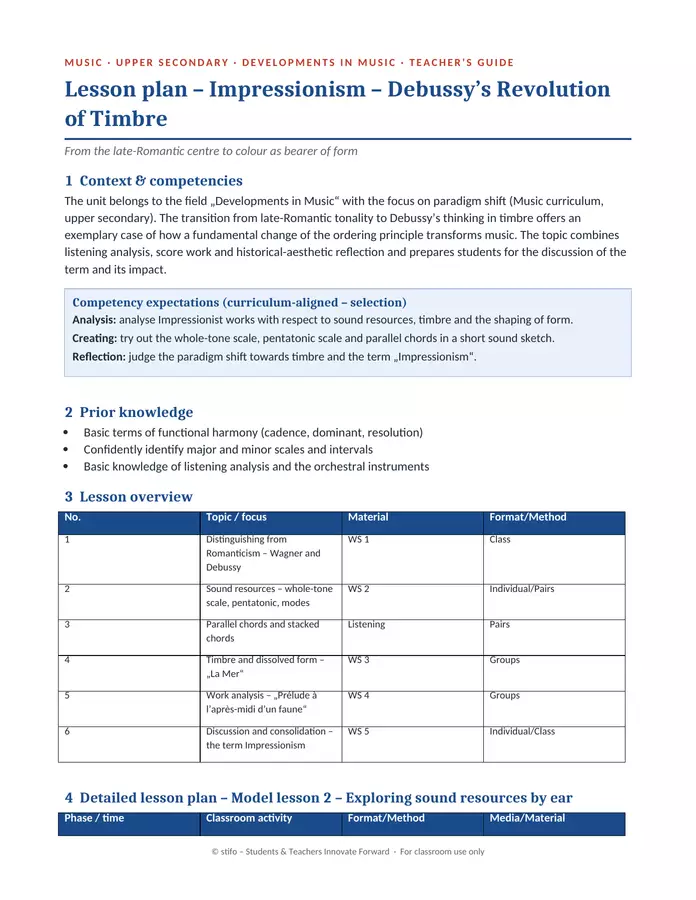
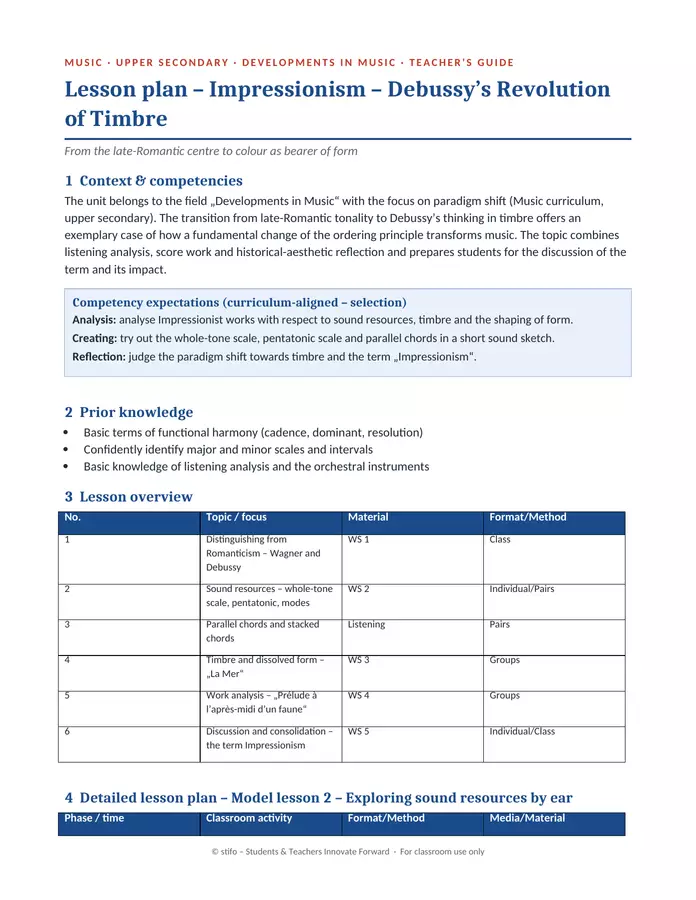


Debussy and Musical Impressionism: an English-language teaching unit for upper secondary Music, Grades 11–13. Five worksheets, three background readings and separate answer keys connect musical concepts with analysis, interpretation and a practical or written response. A teacher lesson plan and classroom presentation support the sequence.
Basics – Distinguishing from Romanticism
I can explain Debussy’s historical position around 1900. I can distinguish Debussy’s thinking about sound from Wagner’s. I can apply the term „paradigm shift“ to music.
Sound resources – Scales, modes and parallel chords
I can recognise the whole-tone and pentatonic scales by ear and in notation. I can describe parallel chords (planing) and stacked chords. I can explain how these means weaken tonality.
Timbre – Orchestration and dissolved form
I can explain timbre as an independent means of shaping. I can describe Debussy’s orchestration through examples. I can explain the term „dissolved form“.
Work analysis – „Prélude à l’après-midi d’un faune“
I can describe the outline of the „Faune“. I can demonstrate sound resources in the actual work. I can place the work’s significance in music history.
Transfer – Painting, music and the term „Impressionism“
I can name parallels between painting and Debussy’s music. I can weigh arguments for and against the term „Impressionism“. I can write a reasoned discursive essay.
Five student worksheets with learning objectives, explanatory material and tasks.
Five separate answer keys with expected responses and assessment guidance.
Three background reading texts: Debussy and the Break with Romanticism; Debussy’s Sound Resources; Timbre as Bearer of Form.
A teacher lesson plan with context, prerequisites, an overview, a detailed model lesson and suggestions for differentiation and assessment.
A classroom slide deck.
One combined printable PDF and a separate archive containing editable text documents and the presentation.
Use the reading texts to introduce the vocabulary and context, then connect the terms with a selected musical example. Ask learners to support an observation with a passage, describe the technique and explain its effect. Comparing interpretations helps distinguish what can be heard or read in the example from a broader judgement. The answer keys support review of both technical knowledge and the quality of a reasoned response.
Listening and score preparation: audio recordings, film clips and a separate collection of licensed score excerpts are not included. The teacher plan suggests examples for classroom use; provide suitable recordings and any score passages needed for the chosen tasks. The download supplies the teaching texts, task sheets, answer guidance and slides. Prepare the playback or projection setup and select excerpts of a manageable length for close listening.
For differentiation, introduce terms together and use focused listening questions or marked score passages supplied by the teacher. More confident learners can compare examples or develop a practical or written transfer response. Select activities according to prior listening, notation and historical knowledge, and allow preparation time before discussion. The editable documents let you adjust the example, task wording and amount of support.
Which language is supplied? This is the English edition; German files are not included. Are answers included? Each worksheet has its own answer key. Are audio files or complete scores included? No. The teacher supplies the listening examples and score passages used in class. Can I edit it? The separate archive contains editable worksheets, answer keys, readings, lesson plan and slide deck.
Source and tool notes from the supplied files are retained. Texts, tasks, answers and design were generated with AI, as declared in the listing. PDF versions of the slides are included in the combined page count; identical editable versions are not counted twice.
Download size: 31 pages in the combined PDF, including one credits and AI-disclosure page. Slide pages are included in this count. The editable archive contains 15 text documents, including an editable credits note, and 1 slide deck.
Twentieth-Century Music: Debussy, Twelve-Tone, Serial and Minimal Music: this bundle contains 5 complete teaching resources with 156 PDF pages in total. Music Grades 11–13. All included resources are the English-language editions. They can be taught separately or selected to build a connected sequence around the named topics.Use the individual packs to introduce concepts, practise subject vocabulary, compare examples and support written or practical outcomes. Select tasks according to learners’ prior knowledge and the level stated in each resource; the bundle is a collection of the listed complete products, rather than a newly sequenced textbook or a promise that every task suits every grade.Which resources are included?Music Grades 11–13: Debussy and Musical Impressionism | 5 Worksheets, Readings & Answers | English Edition · 32 pagesDebussy and Musical Impressionism: an English-language teaching unit for upper secondary Music, Grades 11–13. Five worksheets, three background readings and separate answer keys connect musical concepts with analysis, interpretation and a practical or written response. A teacher lesson plan and classroom presentation support the sequence.Use the reading texts to introduce the vocabulary and context, then connect the terms with a selected musical example. Ask learners to support an observation with a passage, describe the technique and explain its effect. Comparing interpretations helps distinguish what can be heard or read in the example from a broader judgement. The answer keys support review of both technical knowledge and the quality of a reasoned response.Twelve-Tone Technique and Dodecaphony | Music Grades 11–13 | 5 Worksheets & Readings | English Edition · 31 pagesTwelve-Tone Technique and Dodecaphony: an English-language teaching unit for upper secondary Music, Grades 11–13. Five worksheets, three background readings and separate answer keys connect musical concepts with analysis, interpretation and a practical or written response. A teacher lesson plan and classroom presentation support the sequence.Use the reading texts to introduce the vocabulary and context, then connect the terms with a selected musical example. Ask learners to support an observation with a passage, describe the technique and explain its effect. Comparing interpretations helps distinguish what can be heard or read in the example from a broader judgement. The answer keys support review of both technical knowledge and the quality of a reasoned response.Music Grades 11–13: Serial Music and Aleatoric Composition | 5 Worksheets, Readings & Answers | English Edition · 31 pagesSerial Music and Aleatoric Composition: an English-language teaching unit for upper secondary Music, Grades 11–13. Five worksheets, three background readings and separate answer keys connect musical concepts with analysis, interpretation and a practical or written response. A teacher lesson plan and classroom presentation support the sequence.Use the reading texts to introduce the vocabulary and context, then connect the terms with a selected musical example. Ask learners to support an observation with a passage, describe the technique and explain its effect. Comparing interpretations helps distinguish what can be heard or read in the example from a broader judgement. The answer keys support review of both technical knowledge and the quality of a reasoned response.Minimal Music: Repetition, Phasing and Additive Processes | Music Grades 11–13 | English Edition · 31 pagesMinimal Music: an English-language teaching unit for upper secondary Music, Grades 11–13. Five worksheets, three background readings and separate answer keys connect musical concepts with analysis, interpretation and a practical or written response. A teacher lesson plan and classroom presentation support the sequence.Use the reading texts to introduce the vocabulary and context, then connect the terms with a selected musical example. Ask learners to support an observation with a passage, describe the technique and explain its effect. Comparing interpretations helps distinguish what can be heard or read in the example from a broader judgement. The answer keys support review of both technical knowledge and the quality of a reasoned response.Music Grades 11–13: Sound Masses, Clusters and Micropolyphony – Ligeti, Penderecki & Xenakis | English Edition · 31 pagesNew Sound Concepts and Sound Masses: an English-language teaching unit for upper secondary Music, Grades 11–13. Five worksheets, three background readings and separate answer keys connect musical concepts with analysis, interpretation and a practical or written response. A teacher lesson plan and classroom presentation support the sequence.Use the reading texts to introduce the vocabulary and context, then connect the terms with a selected musical example. Ask learners to support an observation with a passage, describe the technique and explain its effect. Comparing interpretations helps distinguish what can be heard or read in the example from a broader judgement. The answer keys support review of both technical knowledge and the quality of a reasoned response.Files, preparation and frequently asked questionsYou receive the complete files of the listed individual products, with the worksheets, answers, teaching notes and presentations described in each listing. File formats and additional preparation vary by resource: consult each included product for its exact inventory. PDF page totals count the complete printable editions, including covers, teaching notes and answers; editable versions are not counted again as extra pages.Teachers provide the selected audio or film examples and any required scores. Audio files, film clips and a licensed score collection are not included.Does this add new worksheets to the individual packs? No. This offer groups the named complete products. If you already own one or more, check the overlap before purchasing. Text, tasks, answers and the supplied cover graphics were fully created with AI. Source references and resource-specific notes are retained in the individual files. The resources have not been classroom tested.Sum of individual prices: 114.95 €. Bundle price: 89.99 € (saving: 21.7%).
Klassenstufen: EF (10./11. Jhg.), Q1 (11./12. Jhg.)



Bewertungen und Kommentare