


1 Seite
5 Seiten
4 Seiten


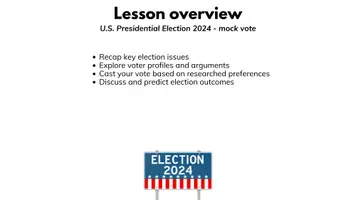
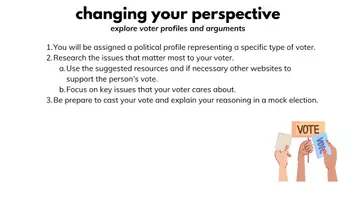


Perfect to talk about the US presidential election 2024 and understanding the diverse electorate better.Contains six voter profiles with the following information:- background- key issues- priorities- resources for researchInstructions for students:You will be assigned a political profile representing a specific type of voter.Research the issues that matter most to your voter. Use the suggested resources and if necessary other websites to support the person’s vote.Focus on key issues that your voter cares about.Be prepare to cast your vote and explain your reasoning in a mock election.Possible application:Distribute the profiles: Randomly assign each student one of the four voter profiles. Provide them with the background information and key issues for their assigned voter.Research the voter's Key Issues: Allow students to consult the provided websites to gather more information about the concerns of their assigned voter.Prepare to vote: After researching, students will use the voter profile’s priorities to argue which candidate aligns best with their needs during the mock election.PS: Auf meinem Profil findest du auch ein Packet inklusive der Präsentationsfolien für den Unterricht.
Klassenstufen: Q1 (11./12. Jhg.), Q2 (12./13. Jhg.)
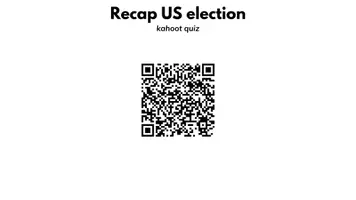
Material includes:- slides for presentation (a slide for each lesson step)- link to recap kahoot about US election- slide with possible lesson planPossible lesson plan:Step 1: Assign Political Profiles (5 minutes)Objective: Students will take on roles representing different voter profiles. You’ll create a set of cards or slips, each containing a brief description of a specific voter persona (e.g., a young college student, a factory worker in a Rust Belt state, an immigrant business owner, a retiree concerned with healthcare, etc.).Each student draws a card, taking on the role of that voter. This helps ensure they don't just vote based on their personal opinions but rather think about the broader electorate.Step 2: Group Discussion – What Would "Your Voter" Want? (5 minutes)Activity: Break students into small groups based on similar or contrasting voter profiles. Let them discuss what their voter’s priorities and concerns might be in the election.For instance, a college student may care about student loan debt and climate change, while a retiree might prioritize healthcare and pensions.Encourage students to think about issues like immigration, healthcare, the economy, education, and gun control. How do these issues affect their assigned voter profile?Step 3: Voter Argumentation (5 minutes)Activity: In pairs or small groups, have students briefly argue why their assigned voter would support a specific candidate (either Biden or Trump). They must base this on the issues relevant to their voter persona. Each student or group should prepare a few sentences about:Who their voter is (e.g., "I represent a 22-year-old university student from Florida.")What issues are most important to that voter.Why this voter would support a specific candidate, based on those issues.Let each pair or group present their reasoning to the class briefly (about 1 minute each).Step 4: The Vote (5 minutes)Activity: Once everyone has presented their argument, conduct a mock election. You can use physical ballots (printed slips of paper) or a digital polling tool (like Mentimeter or Poll Everywhere) to let students cast their votes based on the voter persona they represented.Step 5: Result Analysis (3-5 minutes)Activity: After the vote, reveal the results to the class and lead a quick reflection. Compare the class's mock election results to current polling data. Ask questions like:Were the results what they expected?Did their voter persona sway them toward a different choice than they would have made personally?What issues seemed to have the most influence on their voting decisions?
Klassenstufen: Q1 (11./12. Jhg.), Q2 (12./13. Jhg.)



Bewertungen und Kommentare